

How to Tell If Your AC Needs Replacing (Not Just Repairing)
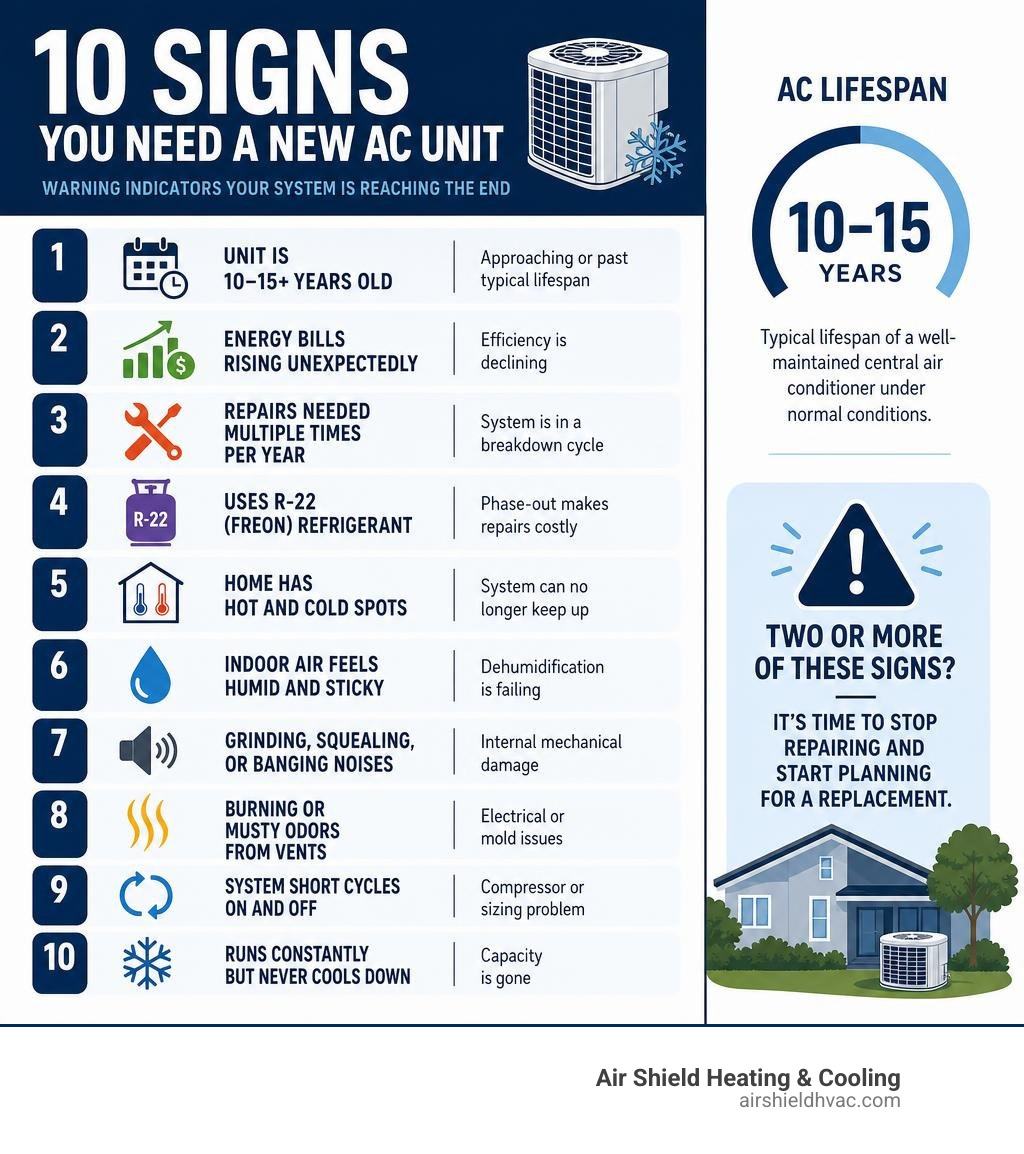
The most common signs you need new AC replacement rather than another repair include:
| Warning Sign | What It Means |
|---|---|
| Unit is 10-15+ years old | Approaching or past typical lifespan |
| Energy bills rising unexpectedly | Efficiency is declining |
| Repairs needed multiple times per year | System is in a breakdown cycle |
| Uses R-22 (Freon) refrigerant | Phase-out makes repairs costly |
| Home has hot and cold spots | System can no longer keep up |
| Indoor air feels humid and sticky | Dehumidification is failing |
| Grinding, squealing, or banging noises | Internal mechanical damage |
| Burning or musty odors from vents | Electrical or mold issues |
| System short cycles on and off | Compressor or sizing problem |
| Runs constantly but never cools down | Capacity is gone |
If two or more of these apply to your current system, it is likely time to stop repairing and start planning for a replacement.
Most homeowners only think about their air conditioner when something goes wrong. That is usually the worst possible moment to find out it needs replacing. You are in the middle of a brutal Florida summer, temperatures outside are pushing past 95 degrees, and your HVAC company has a week-long wait because everyone else’s system is failing at the same time.
The reality is that most AC systems in Florida give you plenty of warning before they completely fail. The problem is that those warnings are easy to overlook or explain away as minor issues. A slightly higher energy bill one month, a strange noise that only happens sometimes, a room that never quite cools down the way it used to. Individually, these things seem manageable. Together, they paint a clear picture that your system is running on borrowed time.
A well-maintained central air conditioner typically lasts 10 to 15 years under normal conditions. But here in Manatee County, FL, our systems work harder than almost anywhere else in the country. The combination of year-round usage, high humidity, coastal salt air, and extreme summer heat puts significantly more stress on equipment than a unit in a northern state might ever experience. That changes the math on when replacement makes more sense than another repair.
The experienced team at Air Shield Heating & Cooling has spent years helping Florida homeowners recognize the signs you need new AC equipment before a full breakdown forces their hand. In the sections below, we’ll walk you through exactly what to look for so you can make a confident, informed decision.
Understanding AC Lifespan and the Signs You Need New AC
When evaluating an older cooling system, it helps to understand how typical wear and tear impacts its longevity. An air conditioner does not simply stop working overnight. Instead, its internal components slowly degrade, losing efficiency and performance capabilities over several years.
To make an informed decision, compare your system’s age, repair history, and daily performance against the Florida lifespan factors that affect local homes. Our breakdown of how long HVAC systems last in Florida explains why year-round heat, humidity, and coastal exposure can shorten the useful life of an AC system in Bradenton, Sarasota, and nearby Gulf Coast communities.
Average Lifespan of a Central AC Unit
Nationwide, a well-maintained central air conditioner typically lasts 10 to 15 years, with some units in cooler northern climates occasionally reaching up to 20 years. However, these national averages can be highly misleading for homeowners in places like Bradenton, FL or Sarasota, FL.
The lifespan of your system is directly tied to its total operating hours. In northern states, an AC might only run for 500 to 1,000 hours per year. In Florida, our units easily log 2,500 to 3,500 operating hours annually. This means a 10-year-old system in our area has endured the mechanical equivalent of a 20-year-old system in a milder climate.
Regular maintenance can certainly extend this lifespan, but eventually, mechanical limits are reached. High humidity levels force the system to run longer cycles to remove moisture, while the coastal salt air in communities like Longboat Key, FL and Holmes Beach, FL accelerates the corrosion of sensitive aluminum outdoor coils.
Why Florida Climates Accelerate the Signs You Need New AC
Living near the Gulf Coast comes with incredible benefits, but it is a harsh environment for mechanical equipment. The constant exposure to elevated humidity, high temperatures, and salt-laden air creates a trifecta of stress for your outdoor condenser unit.
First, there is thermal stress. The heat index in Florida regularly exceeds 100 degrees during the summer months. To keep your home at a comfortable 72 or 75 degrees, your system must work against a massive temperature differential. This forces the compressor to run at peak capacity for hours at a time, accelerating internal wear.
Second, salt air corrosion is a silent killer of outdoor coils. Salt in the air reacts with the copper and aluminum in your condenser, causing a process called galvanic corrosion. This weakens the coils, leads to microscopic refrigerant leaks, and reduces heat transfer efficiency.
When your system cannot shed heat efficiently, it has to run longer and consume more power to achieve the same level of cooling. These environmental factors explain why recognizing the early signs of air conditioner decline is so critical for coastal Florida homeowners.
10 Warning Signs It’s Time for a New Air Conditioner
Recognizing when to transition from repairing an old unit to installing a new one can save you thousands of dollars in wasted utility bills and emergency service calls. It is easy to ignore small performance drops, but they almost always point to a larger systemic issue.
If your current unit is still repairable but showing early warning signs, timely professional AC repair service can help you address the immediate issue and understand whether the system still has reliable life left. When breakdowns become frequent or repair costs begin stacking up, the warning signs below can help you decide when replacement is the better long-term move.
1. Your AC Unit is Over 10 to 15 Years Old
The calendar is one of the most reliable indicators of system health. If your air conditioner was installed more than a decade ago, it is officially entering its retirement years. Even if the unit is still blowing cool air, its internal components are operating with significantly degraded efficiency.
Older systems rely on outdated technology. Over the past decade, HVAC engineering has made massive leaps forward in compressor design, fan motor efficiency, and heat transfer materials. Running an obsolete system means you are paying a premium on your monthly electric bills for subpar comfort.
2. Energy Bills are Skyrocketing Without Explanation
Have you noticed your monthly electric bills creeping upward summer after summer, even though your local utility company has not raised its rates? This is a classic sign of efficiency loss. As compressors wear down and coils corrode, the system must draw more electricity and run for longer periods to remove the same amount of heat from your home.
Air conditioning accounts for as much as 19% of average household energy costs nationwide, but in hot, humid areas like Manatee County, FL, that percentage is often much higher. Upgrading to a higher-efficiency AC unit can reduce cooling energy use by 20% or more, resulting in immediate relief on your monthly utility statements.
3. Frequent and Increasingly Expensive Repairs
Every mechanical system will need an occasional repair, such as a replaced capacitor or a new fan motor. However, if you find yourself calling an HVAC technician multiple times a year, you are caught in a costly repair cycle.
When major components like the compressor or the evaporator coil begin to fail, the cost of these individual fixes can quickly approach the value of a complete system replacement. Investing substantial money into a system that is past its prime is rarely a wise financial decision, especially when those repairs come with no guarantee that another part won’t break down the following month.
4. The System Uses Outdated R-22 Refrigerant
If your air conditioner was manufactured before 2010, there is a very high probability that it uses R-22 refrigerant, commonly known as Freon. Due to environmental regulations regarding ozone depletion, the United States completely phased out the production and importation of R-22 in 2020.
Today, the only R-22 available for servicing older units is reclaimed or recycled refrigerant, which has become incredibly scarce and expensive. If your older system develops a refrigerant leak, recharging it can cost hundreds or even thousands of dollars. Upgrading to a modern system that uses eco-friendly, readily available refrigerants is the only practical long-term solution.
5. Inconsistent Temperatures and Hot Spots
Does your master bedroom feel like a sauna while your living room is ice cold? Inconsistent temperatures throughout your home are a strong indicator that your air conditioner is losing its ability to distribute air evenly.
As systems age, the blower motor weakens, and the compressor struggles to maintain the steady pressure needed to deliver consistent cooling to the furthest reaches of your ductwork. While some minor temperature variations can be caused by duct leaks or poor insulation, widespread hot spots usually point to a failing central unit.
6. Excessive Humidity Indoors
In Florida, cooling is only half of an air conditioner’s job. The other half is dehumidification. A properly functioning system pulls warm, moist air across a cold evaporator coil, causing moisture to condense and drain away outside.
If the air inside your home feels sticky, clammy, or heavy, your AC is no longer dehumidifying effectively. This failure not only compromises your personal comfort but also creates an ideal breeding ground for mold, mildew, and dust mites, which can severely impact your indoor air quality and overall health.
7. Strange Noises Like Grinding or Squealing
Your air conditioner should operate with a relatively quiet, predictable hum. If you start hearing loud grinding, squealing, rattling, or clanking sounds, you should pay close attention.
A squealing sound often indicates a failing blower motor belt or a bearing issue. Grinding noises usually mean the compressor’s internal pistons or bearings are failing, which is a major mechanical breakdown. Ignoring these sounds can lead to a sudden, catastrophic failure of the entire system.
8. Foul or Burning Odors from the Vents
When your AC kicks on, the air coming out of your registers should smell clean and neutral. If you notice a musty, moldy odor, it is highly likely that moisture is pooling inside your air handler or ductwork, leading to biological growth.
Even more concerning is a metallic, burning, or electrical smell. This typically indicates that wiring is overheating, a motor is burning out, or electrical components are failing. If you ever smell burning from your vents, turn off your system at the thermostat immediately and call a professional to prevent a potential electrical fire.
9. Frequent Short Cycling
An air conditioner should run in steady, predictable cycles, typically lasting 15 to 20 minutes, to cool your home and remove moisture. If your system turns on, runs for three minutes, shuts off, and then turns back on again a few minutes later, it is short cycling.
Short cycling puts an immense amount of physical strain on the compressor, which draws the most electrical current during the startup phase. This issue can be caused by a faulty thermostat, low refrigerant levels, or an oversized unit, and it quickly leads to premature system failure.
10. Constant Running Without Reaching the Set Temperature
On the opposite end of short cycling is a system that runs continuously without ever reaching your desired temperature. If your thermostat is set to 72 degrees, but the thermometer on the wall stubbornly reads 78 degrees while the outdoor unit hums all afternoon, your system has lost its cooling capacity.
This continuous operation wastes massive amounts of electricity and subjects every moving part in your system to non-stop wear and tear. It is a clear sign that the compressor is failing or the system can no longer handle the heat load of your home.
The Financial Decision: Repair vs. Replacement Frameworks
Deciding whether to invest in another repair or replace your system entirely does not have to be a guessing game. By looking at the math, you can make an objective, practical decision that protects your household budget.
A helpful starting point is to compare the type of repair, the age of your AC system, and how often performance issues are returning after service.
| Repair Scenario | Typical Lifespan Left | Financial Recommendation |
|---|---|---|
| Minor electrical fix (capacitor, contactor) | Variable | Repair if system is under 12 years old |
| Major component failure (compressor, coil) | Low | Replace if system is over 10 years old |
| Outdated R-22 system with a refrigerant leak | None | Replace immediately |
Applying the $5,000 Rule for Smart Decisions
A widely accepted tool in the HVAC industry is the “$5,000 rule.” This simple calculation helps you weigh the age of your system against the cost of a pending repair to see if replacement is the smarter financial move.
To apply the rule, multiply the age of your air conditioner in years by the exact cost of the recommended repair:
Age of System (Years) x Cost of Repair ($) = Total Score
If the resulting score is under $5,000, repairing the unit is generally a reasonable option. If the score is over $5,000, that money is better spent as a down payment on a new, energy-efficient system.
For example, if you have an 8-year-old system that needs a quick $400 repair, your score is $3,200. In this case, making the repair is highly economical. However, if you have a 12-year-old system facing a $600 repair, your score is $7,200. Because this exceeds the $5,000 threshold, investing in a replacement is the smarter long-term decision.
Evaluating the Signs You Need New AC Against Repair Costs
When dealing with major component failures, the decision often becomes even clearer. Replacing a failed compressor or a leaking evaporator coil on a system that is over a decade old rarely makes economic sense.
These major repairs can easily cost thousands of dollars. When you repair a single major part on an aging system, you still have an old system with dozens of other worn components.
By upgrading instead, you receive a brand-new system with a fresh manufacturer’s warranty, lower monthly operating costs, and improved daily comfort. If you are weighing a major repair against a complete upgrade, our guide to the cost of a new HVAC system can help you understand what affects replacement pricing, equipment options, and long-term value.
Benefits of Upgrading to a Modern High-Efficiency AC System
While the upfront cost of a new air conditioner can feel like a significant investment, the long-term benefits of upgrading are substantial. Modern systems are designed to deliver far superior performance, quieter operation, and dramatic energy savings.
For homeowners in our coastal service area, a properly planned professional AC installation can solve comfort problems that repeated repairs can no longer address. The right replacement system should be sized for your home, matched to your indoor equipment, and installed with Florida humidity control in mind.
Understanding SEER2 Ratings and Energy Savings
In recent years, the HVAC industry transitioned to a new efficiency rating system called SEER2 (Seasonal Energy Efficiency Ratio 2). This standard uses more realistic testing conditions to accurately reflect how systems perform in real-world environments.
In Florida, the current minimum allowable efficiency standard for new residential split-system air conditioners is 14.3 SEER2. If you are replacing an older 10 SEER system, upgrading to a modern, high-efficiency model can cut your cooling energy use by 20% to nearly 50%. This translates directly into lower power bills, allowing the new system to partially pay for itself over time.
Modern Features: Variable-Speed Compressors and Smart Thermostats
Older air conditioners operate like a basic light switch: they are either 100% on or completely off. This single-stage operation leads to temperature swings and poor humidity control.
Modern high-efficiency systems utilize variable-speed compressors. These units can adjust their cooling output in tiny increments, running at lower, whisper-quiet speeds for longer periods. This continuous, low-speed operation provides incredibly consistent indoor temperatures and superior dehumidification.
When paired with a smart thermostat, you gain precise control over your home’s climate, allowing you to monitor and adjust your settings remotely from your smartphone.
2026 Tax Credits and Financial Incentives
The financial incentives available in 2026 make upgrading more accessible than ever. Under the Inflation Reduction Act, homeowners can qualify for federal 25C tax credits of up to $600 for qualifying high-efficiency air conditioners, or up to $2,000 for energy-efficient heat pumps.
Additionally, local utility companies like Florida Power & Light (FPL) offer rebates for qualifying system upgrades. Stacking these government tax credits, utility rebates, and manufacturer promotions can significantly lower your net installation costs. If you want to maximize these savings, you can read my advice on why you should install before January to beat the seasonal rush and secure the best incentives.
To ensure you get the absolute best performance and value from your new system, proper sizing is critical. A professional load calculation protects your investment by matching capacity to your home’s square footage, insulation, window exposure, and local climate demands.
Frequently Asked Questions About AC Replacement
How long does a typical central AC unit last in Bradenton, FL?
In Bradenton, FL and the surrounding Manatee County area, a typical central AC unit lasts between 10 to 15 years. The combination of high humidity, near year-round usage, and corrosive coastal salt air subjects local systems to much higher wear and tear than units in northern states.
What are the most common signs you need new AC equipment?
The most common signs include a system age of over 10 to 15 years, unexplained increases in your monthly electric bills, frequent breakdown repairs, a sticky or humid indoor environment, and the use of outdated R-22 refrigerant.
Is it better to repair or replace a 10-year-old AC unit?
At the 10-year mark, the decision depends on the cost of the repair and the overall condition of the system. If the repair is minor, fixing it may be reasonable. However, if the system needs a major component like a compressor or coil, or if it uses outdated R-22 refrigerant, replacement is usually the smarter long-term financial choice.
How much can I save on my energy bills by upgrading to a high-efficiency AC?
Upgrading from an older, inefficient system to a modern high-efficiency model can reduce your cooling energy costs by 20% to as much as 50%, depending on the efficiency rating of your old unit and the SEER2 rating of the new system.
What is the $5,000 rule in HVAC?
The $5,000 rule is a decision-making tool where you multiply the age of your AC system in years by the cost of the recommended repair. If the total is over $5,000, replacement is recommended. If the total is under $5,000, repairing the unit is typically more cost-effective.
Can I still get parts or refrigerant for an R-22 AC system in 2026?
While some basic parts are still available, R-22 refrigerant was completely phased out of production and importation in 2020. Finding recycled R-22 in 2026 is extremely difficult and expensive, making any refrigerant-related repair on an older system financially unviable.
Should I replace my indoor furnace or air handler at the same time as the outdoor AC?
Yes, it is highly recommended to replace both units at the same time. Modern AC systems are designed as matched indoor and outdoor systems. Mixing a new outdoor unit with an old indoor air handler can reduce efficiency, compromise system reliability, and void your manufacturer’s warranty.
What is the minimum SEER2 rating required for new AC installations in Florida?
For the southern region of the United States, including Florida, the minimum allowable efficiency standard for new residential split-system air conditioning installations is 14.3 SEER2.
How long does the actual AC installation process take?
A standard residential AC replacement is a professional process that typically takes between 4 to 8 hours to complete. If your home requires extensive ductwork modifications or complex electrical upgrades, the installation may take slightly longer.
What size AC unit do I need for my home?
The correct size of your AC unit cannot be determined by square footage alone. A professional HVAC contractor must perform a detailed load calculation that takes into account your home’s square footage, local climate, insulation levels, window types, and roof orientation.
Conclusion
Proactive planning is always superior to emergency decision-making. Waiting for your air conditioner to completely fail during the hottest week of July leaves you with limited options, higher emergency fees, and a rushed decision. By recognizing the early warning signs of system decline, you can take control of your home’s comfort, plan your budget, and choose a high-efficiency system that will keep your family cool for the next decade.
If your system is showing several of the warning signs discussed in this guide, do not wait for a complete breakdown. The experienced, family-owned team at Air Shield Heating & Cooling is here to provide honest, professional guidance tailored to our unique Florida climate.
Whether you need fast AC repairs, seasonal HVAC maintenance, or a complete system replacement, the team at Air Shield Heating & Cooling is ready to help. Contact our professional AC replacement specialists.