
Why Your AC’s Efficiency Rating Matters More Than You Think in Florida
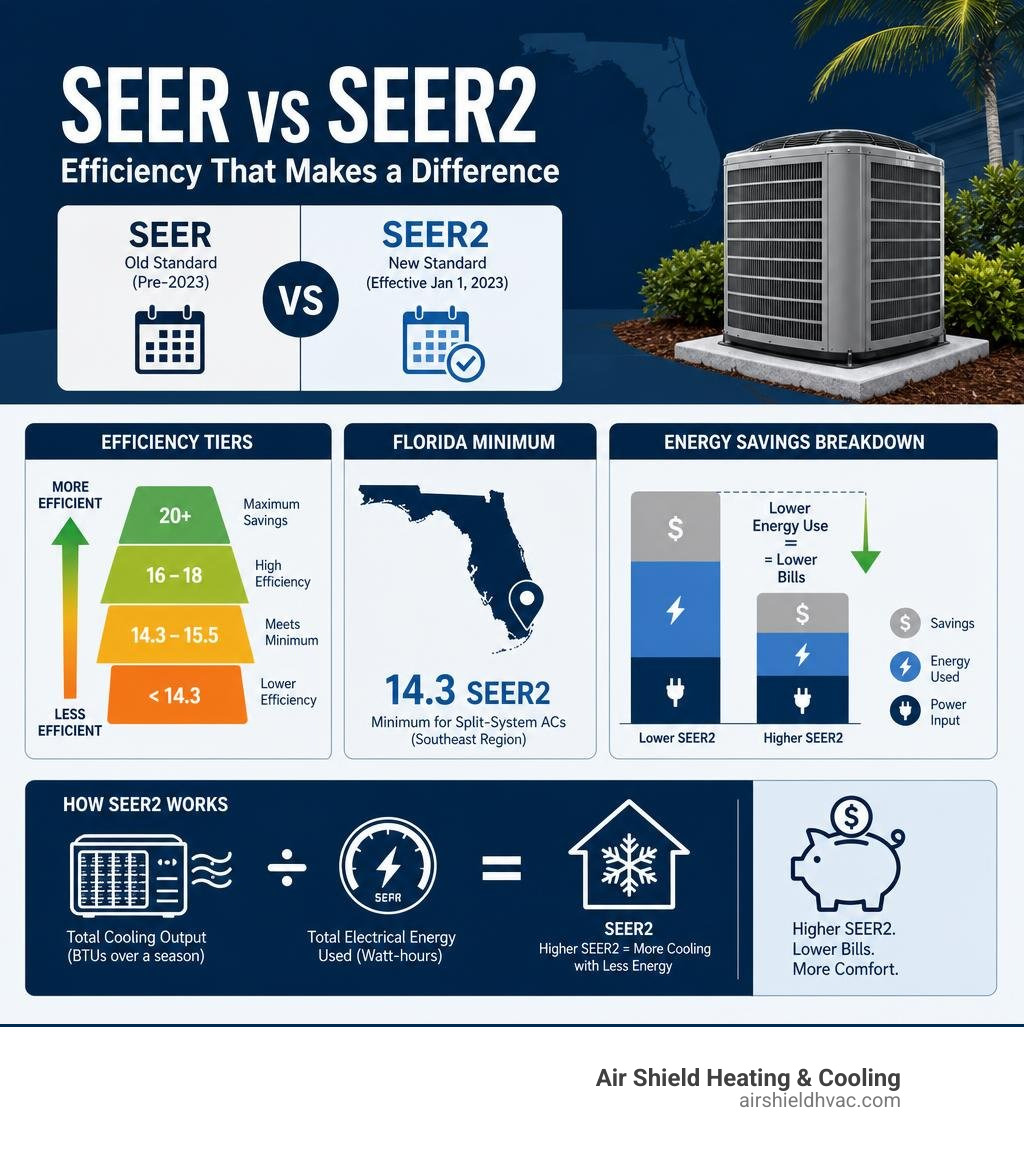
SEER rating explained simply: it stands for Seasonal Energy Efficiency Ratio, and it measures how efficiently your air conditioner cools your home over an entire cooling season. The higher the number, the less electricity your system uses to do the same job.
Quick answer for Florida homeowners:
| Term | What It Means |
|---|---|
| SEER | Seasonal Energy Efficiency Ratio (older standard, pre-2023) |
| SEER2 | Updated efficiency standard effective January 1, 2023 |
| Minimum in Florida | 14.3 SEER2 for split-system ACs (Southeast region) |
| Good SEER2 rating | 16-18 SEER2 for most homes; 20+ for maximum savings |
| Key benefit | Higher SEER2 = lower monthly energy bills |
Here is how SEER is calculated:
SEER = Total cooling output (BTUs) over a season / Total electrical energy used (watt-hours) over that same season
So a unit with a higher SEER2 number delivers the same amount of cooling while consuming less electricity. That difference shows up directly on your utility bill every single month.
For homeowners in Manatee County, FL, this matters more than almost anywhere else in the country. Florida’s long, punishing summers mean your air conditioner runs for months on end, not just a few weeks. When temperatures stay above 90 degrees for the better part of the year, even a modest improvement in efficiency can add up to meaningful savings over time. And with electricity rates continuing to climb, an inefficient system is an expensive one.
If you have ever looked at your summer energy bill and wondered why cooling your home costs so much, the answer often starts with your system’s efficiency rating. Many homes in the Bradenton, FL area are still running older units rated well below today’s standards, sometimes as low as 8 to 10 SEER, when modern minimum requirements have moved significantly higher.
I’m Nick Pazanski, founder of Air Shield Heating & Cooling and an HVAC professional with over two decades of experience helping Florida homeowners navigate decisions exactly like this one. I have seen how a proper understanding of SEER rating explained can help homeowners choose the right system, avoid overpaying on energy bills, and get real comfort from their equipment year-round.
SEER Rating Explained: What It Means and How It Is Calculated
To truly understand how your home stays cool without draining your bank account, we need to break down the mechanics of the seasonal energy efficiency ratio (SEER). Think of SEER as the miles-per-gallon rating for your air conditioner. Just as a car’s MPG tells you how far you can drive on a single gallon of gas, the SEER rating tells you how much cooling comfort you get for every kilowatt-hour of electricity you purchase.
The math behind the rating is straightforward. It compares the cooling output of the system (measured in British Thermal Units, or BTUs) to the total electrical energy consumed (measured in watt-hours) over a simulated, variable cooling season.
Because an air conditioner does not always run under peak summer conditions, the calculation accounts for a range of outdoor temperatures, typically spanning from 65 degrees to 104 degrees Fahrenheit. This gives a realistic seasonal average rather than just a snapshot of how the system performs on the hottest day of the year.
Understanding this calculation is easier when you understand how HVAC systems work in our humid climate. Your air conditioner does not actually “create” cold air; instead, it removes heat and moisture from inside your home and transfers it outdoors.
A higher SEER rating means the compressor, fan motors, and heat exchange coils are engineered to perform this heat transfer process with far less electrical resistance and waste.
The Shift to SEER2: What Has Changed?
If you have been shopping for a new air conditioner recently, you have likely noticed a new term: SEER2. On January 1, 2023, the Department of Energy officially transitioned to this new rating standard, making it the legal benchmark for all new cooling equipment manufactured in the United States.
The shift to SEER2 was driven by a need for accuracy. The old SEER testing methodology, which had been in place for decades, evaluated equipment under laboratory conditions that rarely matched real-world homes.
Specifically, the old test assumed a very low external static pressure, which is the resistance of air flowing through your home’s ductwork. In reality, typical residential duct systems create much more resistance than the old tests accounted for.
Under the updated testing standard, known as the M1 blower testing procedure, the static pressure used during testing was increased by a factor of five. This change forces the system’s blower motor to work much harder during laboratory evaluation, mimicking the actual pressure found in a typical home with standard ductwork.
By testing systems under these more demanding, realistic conditions, manufacturers can provide performance metrics that are far more accurate for real-world home installations.
Why SEER2 Ratings Look Lower Than Legacy SEER
Because the new M1 testing procedure forces the air conditioner to work against higher static pressure (0.5 inches of water column instead of the legacy 0.1 inches), the equipment consumes more energy during the test. Consequently, the resulting efficiency rating drops.
On average, a system’s SEER2 rating will look about 4.5 percent to 5 percent lower than its legacy SEER rating. For example, an air conditioner that was rated at 15 SEER under the old system will carry a rating of approximately 14.3 SEER2 under the new standard.
It is vital to understand that the physical equipment has not become less efficient; rather, the ruler we use to measure its efficiency has simply become more accurate and rigorous.
Regional SEER2 Minimum Requirements in 2026
The Department of Energy does not enforce a single, nationwide minimum standard for air conditioning efficiency. Instead, requirements are broken down by geographical region to account for different climate demands.
As of June 2026, the minimum allowable efficiency standards for split-system air conditioners are:
- Southeastern Region (including Florida): 14.3 SEER2 (equivalent to roughly 15 SEER under the old rules).
- Southwestern Region: 14.3 SEER2 plus strict Energy Efficiency Ratio (EER2) limits.
- Northern Region: 13.4 SEER2 (equivalent to roughly 14 SEER under the old rules).
For us here in Florida, this means you can no longer purchase or legally install a new split-system air conditioner with a rating lower than 14.3 SEER2.
SEER2 vs. EER2: Which Metric Matters for Florida?
When researching new cooling equipment, you will also run across the acronym EER2, which stands for Energy Efficiency Ratio 2. While they sound similar, SEER2 and EER2 measure two entirely different aspects of your system’s performance.
| Feature | SEER2 | EER2 |
|---|---|---|
| Measurement Type | Seasonal average efficiency | Steady-state peak efficiency |
| Outdoor Testing Temp | Variable (65°F to 104°F) | Fixed at 95°F |
| Indoor Testing Temp | Variable | Fixed at 80°F (50% humidity) |
| Best Climate Match | Variable, seasonal climates | Extremely hot, dry desert climates |
| Key Advantage | Reflects overall yearly energy use | Reflects peak grid demand performance |
When to Prioritize EER2 Over SEER2
EER2 is a steady-state efficiency metric. It does not average out performance across a whole season of varying temperatures. Instead, it measures how efficiently the system runs under a specific, high-load condition: exactly 95 degrees Fahrenheit outdoor temperature, 80 degrees indoor temperature, and 50 percent relative humidity.
This metric is highly prioritized in dry, desert climates like Arizona, Nevada, and inland California, where summer temperatures rapidly climb well above 100 degrees and stay there for weeks. In those regions, your air conditioner operates at peak capacity for hours on end, making peak-load efficiency (EER2) the most accurate indicator of your power bill.
Why SEER2 is the Standard SEER Rating Explained for Humid Climates
For homeowners in coastal, humid regions like Bradenton, FL, Sarasota, FL, and Lakewood Ranch, FL, SEER2 remains the primary metric to watch. Our coastal climate brings hot days, but it also features long stretches of mild, highly humid days in the 80s.
In these conditions, modern variable-speed and two-stage systems excel. They do not need to run at 100 percent capacity all day long. Instead, they run at lower speeds for longer periods, which is highly efficient and provides superior humidity control.
Because SEER2 accounts for these part-load conditions, it gives a much better projection of your seasonal energy use than EER2. When evaluating your home’s needs, exploring the different types of air conditioners can help you see how different compressor technologies leverage these ratings.
Financial Benefits of Upgrading to a Higher SEER2 System
Upgrading to a high-efficiency system requires an investment, but the long-term return on that investment can be substantial. The primary benefit of a higher SEER2 rating is the direct reduction in your monthly electric bill.
Calculating Your Potential Energy Savings
The efficiency jump from an older, failing system to a modern high-efficiency unit can yield immediate financial relief. For example, upgrading from a 10 SEER system to a 16 SEER system can reduce your cooling energy consumption by roughly 35 percent.
If we look at modern SEER2 standards, the savings scale up even more:
- 14 SEER2 vs. 18 SEER2: An 18 SEER2 system is about 20 percent more energy-efficient than a standard 14 SEER2 unit.
- 14 SEER2 vs. 20 SEER2: A 20 SEER2 system is roughly 43 percent more efficient than a base-tier 14 SEER2 unit.
- 15 SEER2 vs. 20 SEER2: Making this jump can result in energy savings of up to 33 percent.
If you want to maximize these savings, you can combine a high-efficiency unit with lifestyle adjustments, such as implementing ways to save money on your energy bills.
When your current unit is too inefficient to keep up with Florida’s cooling demand, professional AC installation services can help you compare SEER2 ratings, system size, and long-term operating costs before you choose new equipment.
Tax Credits and Rebates for High-Efficiency HVAC Systems
To help offset the initial purchase cost, federal and local incentives are highly favorable in 2026. Under the Energy Efficient Home Improvement Credit (part of the Inflation Reduction Act), homeowners can claim a federal tax credit of up to 30 percent of the installation cost for qualifying high-efficiency equipment.
For split-system central air conditioners and heat pumps, meeting Energy Star certification requirements (typically 15.2 SEER2 or higher) can unlock up to $2,000 in annual tax credits for heat pumps, or up to $600 for qualifying straight cool air conditioners. Local utility companies in the Manatee County, FL area also offer rebates for installing high-efficiency systems, which your installing contractor can help you claim.
How to Choose the Right SEER2 Rating for Your Bradenton, FL Home
Selecting the perfect SEER2 rating is not about automatically buying the highest number on the market. It is about finding the sweet spot where the upfront cost of the system balances naturally with the energy savings you will see over the system’s lifespan.
Several local factors will influence this decision:
- Home Insulation: If your home has older windows, poor attic insulation, and leaky doors, a high-SEER2 system will still have to work overtime. It is always wise to seal air leaks first.
- Ductwork Quality: Leaky, uninsulated ducts running through a hot Florida attic can lose up to 30 percent of your system’s cooled air, completely erasing the efficiency gains of a high-SEER2 unit.
- Expected System Lifespan: In our salty, humid coastal air, understanding how long HVAC systems last is critical. While a system inland might last 15 years, coastal systems near Bradenton Beach, FL or Holmes Beach, FL face corrosive salt air that can shorten their lifespan.
- Maintenance Habits: Even a 20 SEER2 system will quickly drop in efficiency if the coils are dirty and filters are clogged. Regular maintenance is the best way to extend your AC’s lifespan and keep it running at its rated efficiency.
Sizing Your System with a Manual J Load Calculation
A common mistake is assuming that a bigger air conditioner is always better. In reality, an oversized system will cool your home too quickly and shut off before it has a chance to remove humidity. This leaves your home feeling cold and clammy, and the constant starting and stopping (known as short cycling) ruins the system’s efficiency and wears out the compressor prematurely.
To avoid this, a professional HVAC contractor must perform a Manual J load calculation. This industry-standard calculation takes into account your home’s exact square footage, ceiling heights, window directions, insulation levels, and local climate to determine the precise cooling capacity you need. If you are wondering about the right capacity for your home, you can use our expert guidance on what size HVAC unit you need to understand why proper sizing matters before installation.
If your current system is already struggling, timely AC repair services can help identify whether efficiency problems come from aging equipment, poor airflow, refrigerant issues, or ductwork limitations before you commit to a replacement.
Balancing Upfront Costs with Long-Term Savings
While a 20+ SEER2 variable-speed system offers the ultimate in comfort and energy savings, it does come with a higher initial price tag than a standard 14.3 SEER2 system. To make a smart financial decision, perform a simple payback analysis.
Calculate the difference in installation costs between the two systems, then estimate your annual energy savings. For a busy household in Palmetto, FL or Lakewood Ranch, FL running the AC almost year-round, the payback period for a high-efficiency system is often quite short.
To help you plan your investment, you can research how much a new HVAC system costs and what factors influence that pricing.
Frequently Asked Questions About SEER Ratings
What is a SEER rating explained in simple terms?
A SEER rating is a measurement of an air conditioner’s energy efficiency. It stands for Seasonal Energy Efficiency Ratio and represents the amount of cooling the system produces compared to the amount of electricity it consumes over a typical cooling season. Higher SEER numbers indicate a more efficient system that uses less electricity, resulting in lower monthly energy bills.
What is the difference between SEER and SEER2?
SEER2 is the updated testing standard launched by the Department of Energy on January 1, 2023. Unlike the legacy SEER test, SEER2 uses the M1 testing procedure, which evaluates equipment under five times higher external static pressure to mimic real-world home ductwork. Because of this more rigorous testing, SEER2 ratings are typically about 4.5 percent lower than old SEER ratings for the same equipment.
What is a good SEER2 rating for a Florida home?
For most Florida homeowners, a rating of 16 to 18 SEER2 represents the “sweet spot” of balancing upfront cost with long-term energy savings. While the legal minimum in Florida is 14.3 SEER2, stepping up to a mid-range or high-efficiency variable-speed system in the 16 to 20 SEER2 range provides significantly better humidity control and lower monthly utility bills.
How much can I save by upgrading to a higher SEER2 unit?
Upgrading from an older, inefficient system (such as a legacy 10 SEER unit) to a modern 16 SEER2 unit can reduce your cooling energy costs by roughly 35 percent to 40 percent. If you choose an ultra-high-efficiency system rated at 20 SEER2, you can see up to 43 percent savings compared to a standard baseline 14 SEER2 model.
Does a higher SEER2 rating qualify for tax credits?
Yes, under the federal Energy Efficient Home Improvement Credit, installing an Energy Star certified split-system air conditioner or heat pump (typically requiring 15.2 SEER2 or higher) can qualify you for a federal tax credit of up to $2,000 for heat pumps or up to $600 for central air conditioning systems.
What is the minimum SEER2 requirement in Florida?
As of January 1, 2023, the Department of Energy mandates that all new split-system air conditioners installed in the Southeast region, which includes Florida, must meet a minimum efficiency rating of 14.3 SEER2. Installing any new system below this rating is no longer legally permitted in our state.
How does SEER2 compare to EER2?
SEER2 measures seasonal efficiency over a wide range of outdoor temperatures (65 to 104 degrees Fahrenheit) to simulate a full year of operation. EER2 measures peak-load efficiency at a single, fixed outdoor temperature of 95 degrees Fahrenheit. SEER2 is the best metric for humid, variable climates like Florida, while EER2 is highly prioritized in dry, desert climates with sustained extreme heat.
Does a higher SEER2 unit run quieter?
Generally, yes. High-SEER2 systems usually feature advanced two-stage or variable-speed compressors and high-efficiency fan motors. Because these components can run at lower speeds for long periods rather than constantly cycling on and off at full blast, they operate much more quietly, often producing sound levels as low as 50 to 60 decibels.
How long do high-efficiency HVAC systems last?
In Florida, a well-maintained air conditioner or heat pump typically lasts between 10 and 15 years. Systems installed in coastal areas like Anna Maria Island, FL or Longboat Key, FL may have slightly shorter lifespans due to salt air corrosion, making regular professional maintenance and protective coil coatings highly important.
Can a poorly installed system lower my actual SEER2 rating?
Absolutely. An air conditioner can only achieve its laboratory-rated SEER2 efficiency if it is properly sized, paired with matching indoor equipment, and connected to a well-designed, sealed duct system. Poor installation, incorrect refrigerant charge, or leaky ducts can easily degrade your system’s real-world efficiency by 20 percent to 30 percent.
Conclusion
Navigating HVAC efficiency metrics can feel overwhelming, but understanding how SEER2 works is the key to keeping your home comfortable and your energy bills manageable. Choosing the right efficiency level for your home is not a decision you have to make alone.
Whether you reside in Bradenton, FL, Palmetto, FL, Ellenton, FL, or Lakewood Ranch, FL, the family-owned team at Air Shield Heating & Cooling is dedicated to helping you find the perfect cooling solution. We have been serving Manatee County since 2014, offering 24/7 emergency response, free estimates on system replacements, and exclusive club memberships to keep your equipment running at peak efficiency.
If you are ready to lower your utility bills and experience true indoor comfort, contact our professional AC installation specialists.