
How to Choose the Right AC Size for Your Florida Home
Using an AC sizing calculator is the fastest way to figure out what size air conditioner your home actually needs before you spend money on equipment or installation. Here is a quick reference to get you started:
Quick AC Sizing Reference (Florida Climate)
| Home Size (sq ft) | Estimated Tonnage | Estimated BTU |
|---|---|---|
| 500 – 700 | 1.5 tons | 18,000 BTU |
| 700 – 1,000 | 1.5 – 2 tons | 18,000 – 24,000 BTU |
| 1,000 – 1,300 | 2 – 2.5 tons | 24,000 – 30,000 BTU |
| 1,300 – 1,600 | 2.5 – 3 tons | 30,000 – 36,000 BTU |
| 1,600 – 2,000 | 3 – 3.5 tons | 36,000 – 42,000 BTU |
| 2,000 – 2,500 | 3.5 – 4 tons | 42,000 – 48,000 BTU |
| 2,500 – 3,000 | 4 – 5 tons | 48,000 – 60,000 BTU |
Note: Florida’s heat and humidity typically push these numbers toward the higher end of each range.
These numbers are a starting point. Florida homes in Manatee County, FL and surrounding areas face some of the most demanding cooling conditions in the country. The combination of intense summer heat, high humidity, and long cooling seasons means that getting your AC size right is not just a comfort issue. It directly affects your energy bills, indoor air quality, and how long your system lasts.
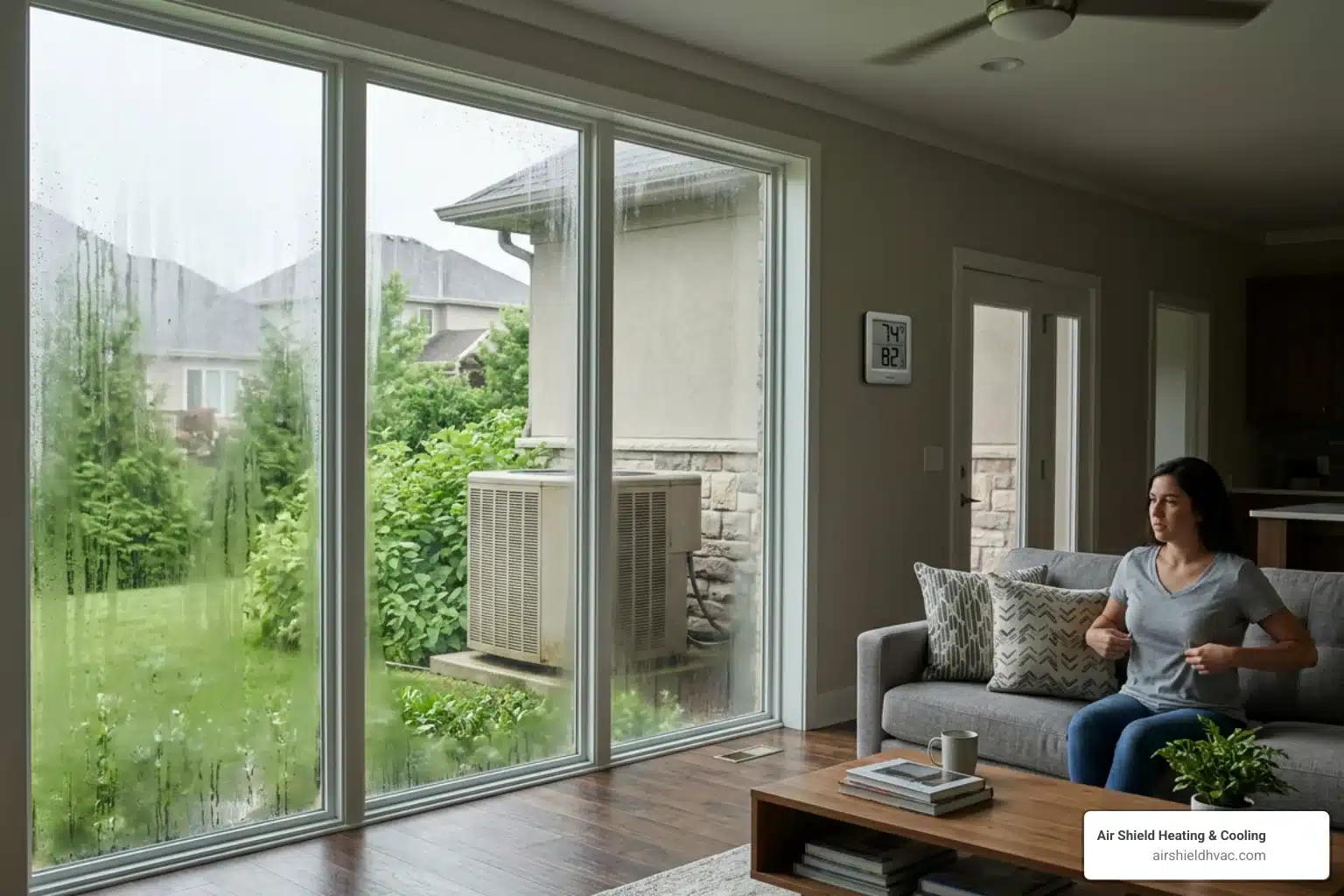
Pick a unit that is too small and it will run nonstop, struggle to keep up on the hottest days, and wear out years ahead of schedule. Pick one that is too large and it will cycle on and off too quickly, fail to pull enough moisture from the air, and leave your home feeling clammy even when the thermostat reads 74 degrees. Neither scenario is good, and both cost you money.
This guide walks you through every factor that influences AC sizing in a Florida home, from square footage and ceiling height to insulation quality, window types, and climate zone adjustments specific to our region.
At Air Shield Heating & Cooling, our HVAC team has over two decades of hands-on experience helping homeowners in Manatee County, FL choose the right AC sizing approach for their specific homes and budgets. We have seen how a properly sized system transforms comfort and cuts energy waste, and we have put that experience into this guide to help you make a confident, informed decision.
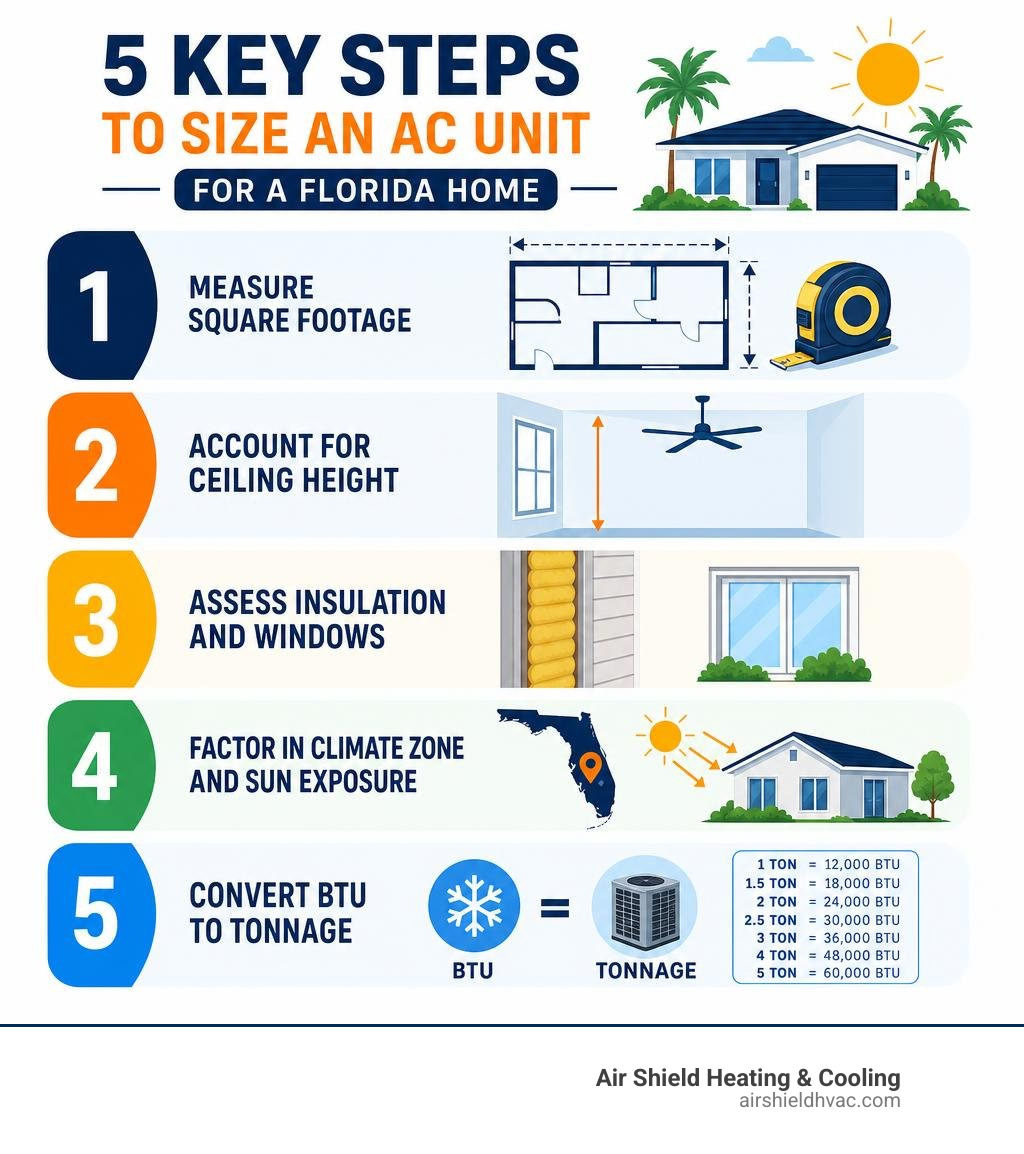
Understanding BTUs and Tonnage in Florida Climates
To understand how an air conditioner is sized, we have to look at the two main units of measurement used in the HVAC industry: BTUs and tonnage.
A BTU, or British Thermal Unit, is a basic measure of thermal energy. Specifically, it is the amount of energy required to raise the temperature of one pound of water by one degree Fahrenheit. In air conditioning, BTUs represent cooling capacity. When we say an AC unit is rated for 24,000 BTUs, we mean it has the capacity to remove 24,000 BTUs of heat from your home every hour.
Tonnage is simply a larger unit of measurement. One ton of cooling capacity is equal to 12,000 BTUs per hour. The term actually dates back to the 19th century ice trade, when cooling was measured by the amount of heat required to melt one short ton of ice over a 24 hour period. Today, residential central AC units are sold in half ton increments, typically ranging from 1.5 tons (18,000 BTUs) up to 5.0 tons (60,000 BTUs).
In Florida, your air conditioner has to handle two distinct types of heat loads:
- Sensible Load: This is the heat you can actually feel, which registers directly on your thermostat. It comes from the sun beating down on your roof, warm air outside, and heat generating appliances.
- Latent Load: This is the moisture or humidity in the air. Lowering the humidity requires energy because the AC must condense water vapor out of the air and drain it away.
Because our local climate is incredibly humid, a massive portion of your AC system’s workload goes toward managing this latent load. If you want to dive deeper into the mechanics of how these systems manage both temperature and humidity, our article on understanding how HVAC systems work explains how the refrigeration cycle handles the unique demands of coastal Florida.
Why You Need an Accurate AC Sizing Calculator
When homeowners ask me for advice, they often assume that buying a larger AC unit is always the safer bet. After all, shouldn’t a bigger system cool the house faster? In reality, installing an oversized system is one of the most expensive mistakes you can make.
If your air conditioner is too large for your square footage, it will experience a phenomenon called short-cycling. The system turns on, blasts the home with cold air, satisfies the thermostat in five to ten minutes, and shuts off. While the temperature drops quickly, the system does not run long enough to pull moisture out of the air. This leaves you with a cold but damp and clammy home, which is the perfect breeding ground for mold and mildew. Furthermore, the constant starting and stopping places immense stress on the compressor, which can cause an oversized unit to fail in just 5 to 8 years instead of its normal 12 to 15 year lifespan.
On the flip side, an undersized unit is equally problematic. It will run continuously on hot July afternoons, struggling to reach your target temperature. This constant operation spikes your monthly electric bills and burns out the fan motor and compressor prematurely.
To avoid these issues, use an AC sizing calculator as a starting point to estimate your home’s cooling needs based on square footage, insulation, windows, ceiling height, and Florida’s humidity. An accurate calculation helps your system run in optimal 15 to 20 minute cycles, which supports better dehumidification, lower energy bills, and longer equipment life.
Key Environmental Factors That Modify Your Cooling Load
A basic square footage rule of thumb (like “1 ton per 600 square feet”) is a starting point, but it ignores the physical characteristics of your home. Two homes of identical size can have completely different cooling requirements based on construction materials, design, and age.
To illustrate how these variables change your actual cooling needs, let us look at how different modifications scale your baseline load:
| Factor / Variable | Impact on Cooling Load | Real-World Sizing Effect |
|---|---|---|
| Poor Insulation (Older homes, minimal attic barrier) | Increases load by 15% | May require bumping up by 0.5 tons |
| Excellent Insulation (New construction, high R-value) | Decreases load by 15% | Allows for a smaller, more efficient unit |
| High Vaulted Ceilings (Over 8 feet tall) | Adds 10% per extra foot of height | Increases the total volume of air to be cooled |
| Single-Pane Windows | Leaks roughly 1,000 BTU per hour | Drastically increases solar heat gain |
| Triple-Pane Low-E Windows | Leaks closer to 300 BTU per hour | Keeps heat out, lowering required tonnage |
| Home Age (e.g., 1970s vs. 2020s build) | Older homes need up to 1.25x tonnage | Accounts for air leaks and degraded insulation |
If you are currently evaluating your property to determine how these factors apply to your situation, our guide on choosing the right HVAC unit size gives practical steps for assessing your home’s layout, insulation, windows, and airflow before selecting equipment.
How Ceiling Height and Sun Exposure Affect the AC Sizing Calculator
Standard cooling calculations assume an 8 foot ceiling. However, many modern homes in Bradenton, FL and Lakewood Ranch, FL feature beautiful vaulted or tray ceilings. Every foot of ceiling height above 8 feet adds about 10 percent to your overall cooling load because it increases the total volume of air in the room.
Sun exposure is another major driver of solar heat gain. A home with west-facing picture windows that receive direct afternoon sun will require a significantly higher BTU capacity than a heavily shaded home facing north. If your home has rooms that bake in the Florida sun all afternoon, your AC sizing calculator must account for this extra heat load to prevent hot spots.
How Insulation and Windows Impact Your AC Sizing Calculator Results
The envelope of your home determines how much outdoor heat leaks inside. Insulation quality is measured by R-value, which represents thermal resistance. Older homes built in the 1970s often have settled or degraded insulation, requiring up to 25% more cooling capacity than a home built in 2020 under modern building codes.
Windows are the weakest point in any home’s thermal envelope. A single-pane window can leak around 1,000 BTUs of heat per hour into your living space on a hot day. Upgrading to double-pane or triple-pane windows with low-E glass can reduce heat transfer significantly, which may lower your required AC capacity and help the system maintain steadier comfort. When comparing AC sizes, factor in your window type, sun exposure, and air sealing so the final estimate reflects how your home actually gains heat.
Sizing Different Types of Air Conditioning Systems
The type of air conditioning system you install also dictates how you calculate and apply your cooling capacity.
- Central AC Systems: These systems rely on a network of ductwork to distribute air. Because ducts run through hot attics, central systems must account for duct heat gain and air leakage, which can waste 20 to 30% of conditioned air.
- Ductless Mini-Splits: Mini-splits deliver air directly to individual zones without ducts, making them incredibly efficient. Since there is no duct loss, you can often size a mini-split zone slightly tighter than a central system zone.
- Portable ACs: Portable units sit inside the room and exhaust hot air through a flexible hose. Because the unit itself emits heat back into the space, portable ACs require a different rating system called the Department of Energy (DOE) rating. A portable AC needs a much higher raw BTU rating to cool the same square footage as a window or mini-split unit.
- Window Units: These are self-contained and sit in a window frame, exhausting heat directly outside. They are excellent for localized cooling but are generally sized for single rooms rather than open areas.
If you are debating between these configurations for a home addition, sunroom, or whole-house remodel, our breakdown of the different types of air conditioners highlights the pros and cons of each setup so you can match the system type to the space.
The Relationship Between Tonnage, SEER2, and Operating Costs
Once you establish the correct tonnage for your home, the next major decision is selecting the efficiency tier. Efficiency is measured by the Seasonal Energy Efficiency Ratio 2 (SEER2), which replaced the older SEER standard to reflect real-world operating conditions more accurately.
Jumping to a higher SEER2 rating can yield massive savings on your monthly electric bills in Florida, where systems run for thousands of hours each year. For example, upgrading from an older, legacy 13 SEER system to a modern 16 SEER2 unit can save you roughly 20% on your annual cooling costs.
While high-efficiency variable-speed units (which often reach 20+ SEER2) have a higher upfront purchase price, they run at lower speeds for longer periods. This provides unmatched humidity control and whisper-quiet operation. Homeowners can also take advantage of local utility rebates and federal tax credits, such as the Section 25C tax credit, which offers up to $600 for qualifying high-efficiency central AC installations. To help you budget for an upgrade, you can read our breakdown on the cost of a new HVAC system to understand how equipment sizing and efficiency ratings affect your overall investment.
Online Calculators vs. Professional Manual J Load Calculations
While an online AC sizing calculator is an excellent tool for budgeting and getting a realistic ballpark estimate, it should never replace a professional evaluation. Online tools are usually within 10 to 15% of the correct size for simple, single-story homes, but they cannot capture every structural variable.
A certified HVAC professional uses a scientific methodology called an ACCA Manual J load calculation. This process involves a room-by-room analysis of your home, factoring in:
- The exact orientation of your home relative to the sun
- The precise square footage and U-factor of all windows and doors
- Internal heat gains from specific appliances, electronics, and lighting
- The condition and location of your ductwork
Sizing the equipment is only half the battle. If your ductwork is leaky, restricted, or poorly insulated, even a perfectly sized AC unit will struggle. Leaky ducts can waste up to 30% of your conditioned air, forcing you to buy a larger system to compensate. Sealing your ducts is almost always more cost-effective than buying a larger AC.
If you are ready to upgrade your system or want to ensure your home’s infrastructure is prepared for a new unit, Air Shield Heating & Cooling provides air conditioning services for Florida homeowners who need help evaluating comfort issues, airflow problems, and system options before investing in new equipment.
For urgent cooling problems, our emergency air conditioning repair services can help diagnose whether poor performance is caused by sizing, duct leakage, refrigerant issues, or failing components before you commit to replacement.
Frequently Asked Questions About AC Sizing in Florida
How many BTUs do I need per square foot in Bradenton, FL?
In our hot and humid Florida climate, you generally need between 25 and 30 BTUs of cooling capacity per square foot of living space. This is slightly higher than the national average because our extreme heat index and high humidity levels place a heavier latent load on the equipment.
What happens if my AC unit is too large for my home?
An oversized AC unit will short-cycle, meaning it turns on and off rapidly. Because it satisfies the thermostat temperature too quickly, it fails to run long enough to remove humidity from the air. This results in a cold, damp indoor environment, accelerated equipment wear, higher electric bills, and a significantly increased risk of mold growth.
How does a Manual J calculation differ from an online AC sizing calculator?
An online calculator uses broad regional heuristics and basic user inputs to give a quick estimate. A Manual J calculation is a highly precise, scientific formula recognized by the ACCA. It factors in exact window orientations, insulation values, local design temperatures, duct leakage rates, and internal heat gains to determine the exact BTU capacity required.
Does ceiling height change the required AC tonnage?
Yes. Standard calculations assume an 8 foot ceiling. If your home has vaulted, tray, or cathedral ceilings, the volume of air in the space increases. As a rule of thumb, every foot of ceiling height above 8 feet adds approximately 10 percent to your overall cooling load.
What is the difference between SEER and SEER2 ratings?
SEER2 is the updated efficiency standard implemented to replace the older SEER rating. SEER2 testing uses a higher external static pressure to mimic real-world ductwork conditions more accurately. A 16 SEER unit is roughly equivalent to a 15.2 SEER2 unit under the updated testing protocols.
How do leaky air ducts affect my AC sizing needs?
Leaky ducts can lose up to 30% of your system’s conditioned air into unconditioned spaces like your attic or crawlspace. This loss forces your air conditioner to work much harder, often leading homeowners to mistakenly install a larger, more expensive AC unit when they actually just need to seal their ductwork.
Should I choose a single-stage, two-stage, or variable-speed AC?
Single-stage units run at 100% capacity all the time, which is less efficient in humid climates. Two-stage units offer a high and low setting, which improves dehumidification. Variable-speed systems are the gold standard for Florida because they continuously adjust their output to match your home’s exact real-time heat load, providing unmatched humidity control and efficiency.
How do I find the tonnage of my current AC unit?
You can find your current system’s tonnage by looking at the data plate on your outdoor condenser. Locate the model number and look for a two-digit number divisible by 6 or 12. For example, if the model number contains “36”, that represents 36,000 BTUs, which is a 3 ton unit. If it contains “24”, it is a 2 ton unit.
Do portable AC units require different BTU calculations?
Yes. Portable AC units draw indoor air across their coils and exhaust heat through a hose, which naturally radiates some heat back into the room. Because of this, they use a specific DOE BTU rating, which is lower than their traditional ASHRAE rating. Always look at the DOE rating when sizing a portable unit.
Can a heat pump replace a traditional AC and furnace in Florida?
Absolutely. In Florida, where winters are exceptionally mild, a heat pump is an incredibly efficient option. It functions exactly like a standard air conditioner during the hot summer months, but it can reverse its cycle to provide highly efficient heating on the handful of chilly winter nights we experience.
Conclusion
Sizing an air conditioning system for a Florida home requires balancing your home’s physical layout, insulation levels, window efficiency, and local humidity demands. While a quick look at an AC sizing calculator can point you in the right direction, working with a local professional is the only way to guarantee your new system is sized perfectly for long-term comfort and efficiency.
At Air Shield Heating & Cooling, we have been proud to serve our neighbors across Manatee County, FL, including Bradenton, FL, Sarasota, FL, Palmetto, FL, and Lakewood Ranch, FL, since 2014. As a family-owned business, we believe in doing things right the first time. We never rely on generic shortcuts; instead, we perform comprehensive evaluations to ensure your equipment is a perfect match for your home. We are proud to offer free estimates, 24/7 emergency response, exclusive club memberships, and veteran discounts to support our community.
Whether you need fast AC repairs, seasonal HVAC maintenance, or a complete system replacement, the team at Air Shield Heating & Cooling is ready to help. Contact our professional AC sizing specialists to schedule your evaluation with our experienced technicians.