
Single-stage vs. Two-stage AC in Florida: What Palmetto Homeowners Need to Know
When it comes to single stage vs two stage AC systems in Florida, the stakes are higher than in almost any other state. Florida’s relentless heat, suffocating humidity, and near year-round cooling season mean that the compressor technology inside your AC unit directly affects your comfort, your monthly energy bills, and even the air quality inside your home. Choosing the wrong system for Palmetto, FL can mean sticky indoor air, uneven temperatures, and a unit that burns out years ahead of schedule.
Quick answer: single-stage vs. two-stage AC in Florida
Here is a fast comparison to help you understand your options:
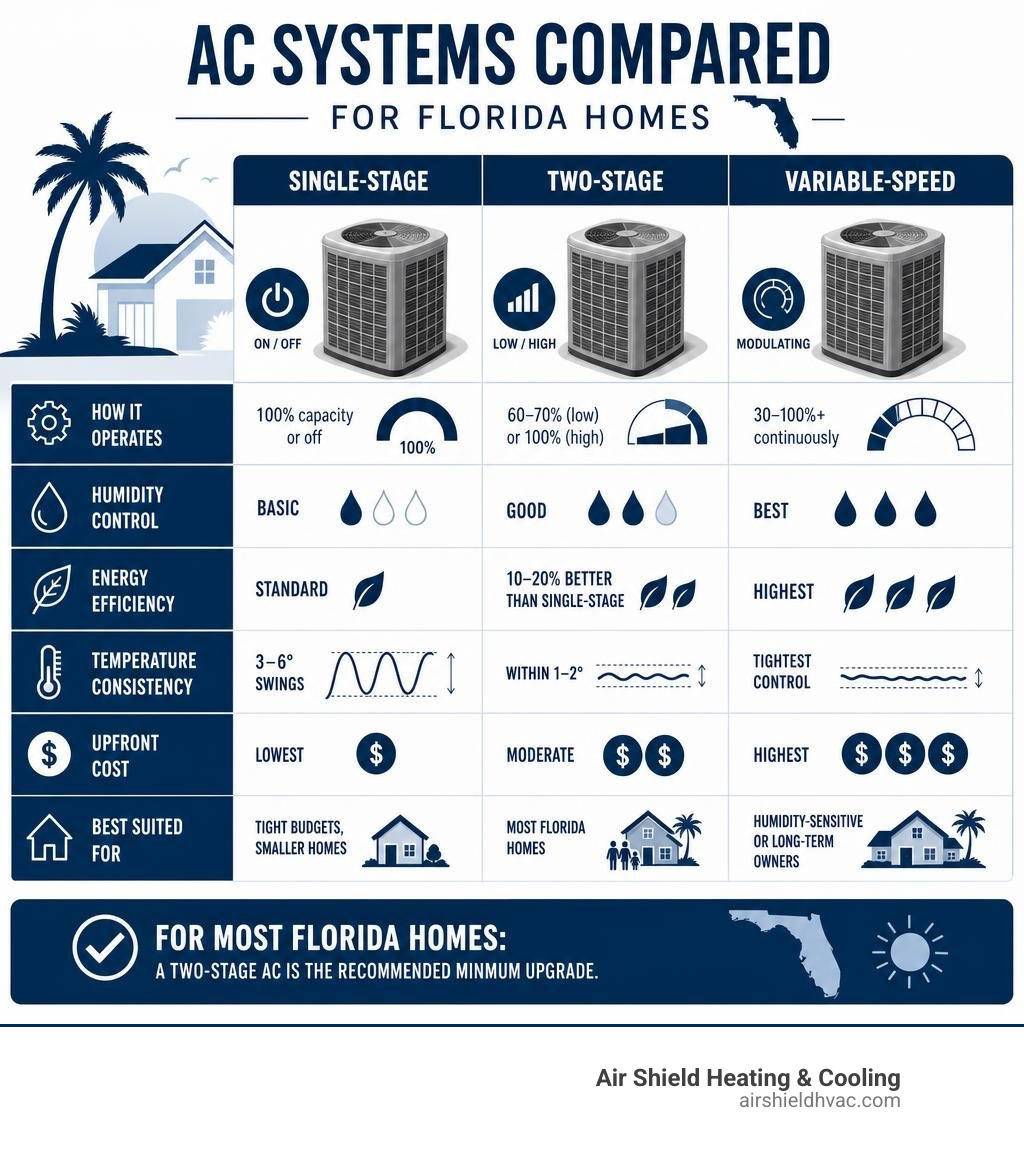
| Feature | Single-stage AC | Two-stage AC | Variable-speed AC |
|---|---|---|---|
| How it operates | 100% capacity or off | 60-70% (low) or 100% (high) | 30-100%+ continuously |
| Upfront cost | Lowest | Moderate (roughly 20-30% more) | Highest |
| Humidity control | Basic | Good | Best |
| Energy efficiency | Standard | 10-20% better than single-stage | Highest |
| Temperature consistency | 3-6 degree swings | Within 1-2 degrees | Tightest control |
| Best suited for | Tight budgets, smaller homes | Most Florida homes | Humidity-sensitive or long-term owners |
Bottom line for Florida homeowners: A two-stage AC is the recommended minimum upgrade for most homes in Palmetto, FL. The longer low-stage run cycles remove significantly more moisture from your air, which is critical in a climate where humidity is the real enemy. Variable-speed systems offer the highest level of comfort and efficiency but come at a higher price point. Single-stage units are the most affordable upfront but can struggle to keep indoor humidity at comfortable levels during Florida’s long cooling season.
Florida is not a “mild climate” scenario. Palmetto, FL sits in Manatee County, where summer dew points regularly climb into the mid-70s and AC systems run for thousands of hours each year. That kind of demand exposes the weaknesses of a basic single-stage system very quickly. A single-stage unit does one thing: blast cold air at full power until the thermostat is satisfied, then shut off completely. On a typical humid Florida afternoon, that cycle may cool the air temperature fast enough to satisfy the thermostat while leaving your home feeling damp and uncomfortable. Two-stage and variable-speed systems solve that problem by running longer at lower capacity, which gives the coil more time to pull moisture out of the air before the unit cycles off.
If you have ever walked into a home that felt clammy despite the AC running constantly, that is almost certainly a humidity control problem, not just a temperature problem. It is one of the most common complaints from homeowners in this region, and it is exactly the kind of issue that upgrading your compressor technology can address.
At Air Shield Heating & Cooling, our team has over two decades of hands-on HVAC experience helping Manatee County homeowners navigate decisions like single stage vs two stage AC in Florida. In the sections below, we will walk you through how each system type works, how they compare in real Florida conditions, and how to figure out which one makes sense for your home and budget.
Understanding compressor technology: single-stage vs. two-stage vs. variable-speed
To make an informed decision, we first need to look past the metal cabinet sitting outside your home and explore what actually happens inside the compressor. The compressor is the heart of your air conditioner, responsible for pumping refrigerant through the system to absorb heat from inside your home and release it outdoors.
How your compressor modulates its capacity determines how your system manages both temperature and humidity. If you are still comparing the basics, our overview of how HVAC systems work explains how the indoor coil, outdoor condenser, refrigerant lines, and blower work together before you choose a new system.
When comparing these technologies, we are looking at three distinct generations of compressor engineering:
- Single-stage systems: These operate like a standard light switch. They are either 100% on or completely off.
- Two-stage systems: These operate like a high/low switch. They can run at a gentle, low capacity for mild days or ramp up to full power when the heat peaks.
- Variable-speed systems: These operate like a dimmer switch. They continuously adjust their output in tiny increments to match the exact cooling load of your home.
Single-stage AC systems: simple and budget-friendly
A single-stage AC is the traditional standard for residential cooling. Its compressor has a single speed and a fixed compression ratio. When your indoor thermostat detects that the temperature has risen above your setpoint, it sends a signal to the outdoor unit. The compressor roars to life at 100% capacity, running at full blast until the indoor temperature drops to the target level, and then shuts down completely.
While this simple on/off operation is highly reliable and keeps the upfront purchase cost lower, it comes with notable trade-offs. Because the system always runs at maximum power, it cools your home very quickly. In a hot, humid climate like Palmetto, FL, this rapid cooling can actually be a disadvantage. The system often satisfies the thermostat in 10 minutes or less, which is called short-cycling.
Because the system shuts off so fast, it does not run long enough to pull significant moisture out of the air. This results in indoor temperature swings of 3 to 6 degrees and a home that feels cold but clammy.
Two-stage AC systems: the balanced middle ground
A two-stage system features a compressor that can operate at two distinct capacity levels: a low stage (typically operating at 60% to 70% of the unit’s total capacity) and a high stage (100% capacity).
Most of the time, your home does not need the full cooling power of your AC. On mild days, or during the cooler morning and evening hours, a two-stage system will run continuously on its low setting. Because it runs at a lower capacity, the cooling cycle is longer and much gentler. Instead of a quick 10-minute blast of cold air, the system might run for 20 to 30 minutes at a lower, quieter speed.
These extended cycles are incredibly beneficial for indoor comfort. They allow the air inside your home to pass through the cold indoor coil multiple times, which extracts significantly more moisture. When the outdoor temperature spikes during a scorching July afternoon, the system automatically ramps up to 100% capacity to keep your home perfectly cool. To compare this option with other equipment choices, our breakdown of different types of air conditioners covers the factors homeowners should weigh before installation.
Variable-speed AC systems: premium comfort and efficiency
Variable-speed systems represent the absolute pinnacle of modern HVAC engineering. Instead of having one or two fixed speeds, a variable-speed compressor uses inverter technology to continuously modulate its output in tiny increments, sometimes adjusting across hundreds of distinct operating levels from 25% to 100% (and occasionally up to 150% for quick cooling needs).
A variable-speed system is designed to run almost continuously at very low, highly efficient speeds. It calculates exactly how much heat is entering your home and matches that heat gain with an equal amount of precise cooling. Because the compressor rarely shuts off, temperature fluctuations are virtually eliminated, keeping your indoor climate within a fraction of a degree of your thermostat setting.
This continuous operation allows for unparalleled dehumidification, making it an exceptional choice for coastal Florida properties. If you are looking for alternative ways to implement variable-speed comfort, you might also consider looking into smart cooling with ductless mini split systems, which use similar inverter-driven technology.
Single stage vs two stage AC Florida: the ultimate comparison
Choosing between a single stage vs two stage AC in Florida requires looking closely at how these systems handle our unique coastal environment.
How humidity control differs in a single stage vs two stage AC Florida comparison
In Palmetto, FL, relative humidity is often the primary source of summer discomfort. High humidity prevents your body from evaporating sweat efficiently, making a 78-degree room feel like 82 degrees.
When you run a single-stage AC, the system cools the air so rapidly that the thermostat is satisfied before the evaporator coil has time to condense and drain away the airborne moisture. The air gets cold, but the relative humidity remains high, often hovering between 55% and 65%. This clammy environment often tempts homeowners to lower their thermostats even further, which wastes energy and places extra stress on the equipment.
A two-stage system solves this problem. Because it spends roughly 70% to 80% of its operating hours running on its lower, longer stage, the air is constantly circulated over the cold evaporator coil. This extended contact time allows the system to remove up to 30% more moisture than a standard single-stage unit.
By holding your indoor relative humidity closer to an ideal 45% to 50%, you will feel much cooler and more comfortable, allowing you to set your thermostat a few degrees higher without sacrificing comfort. Furthermore, keeping humidity levels low is your home’s primary defense against indoor mold and mildew growth.
Energy efficiency and long-term savings
In June 2026, energy efficiency is a top priority for Florida homeowners facing rising utility rates. While a system’s overall efficiency is dictated by its SEER2 (Seasonal Energy Efficiency Ratio 2) rating, compressor staging plays a massive role in real-world energy consumption.
Starting and stopping an electric motor requires a massive surge of electrical current, similar to how a car consumes more fuel in stop-and-go city traffic than it does cruising on the highway. Because single-stage systems cycle on and off frequently, they consume a significant amount of starting energy.
A two-stage system avoids this constant starting stress. By running longer, gentler cycles at a lower capacity, it uses far less electricity over the course of the day. Upgrading to a two-stage system can deliver 10% to 20% energy savings compared to a single-stage unit of the same capacity. Over our long Florida cooling seasons, those monthly savings add up quickly, helping to offset the upfront price premium of the multi-stage equipment.
System lifespan and wear and tear
An air conditioner in Palmetto, FL works incredibly hard, often running for thousands of hours every single year. This constant operation takes a toll on the mechanical components of your system.
The most stressful moments in a compressor’s life are when it starts up. The sudden rush of electrical current and the immediate physical strain of ramping up to full speed create mechanical friction and heat. Because single-stage systems short-cycle frequently, their compressors experience accelerated wear and tear.
Two-stage and variable-speed systems experience far fewer start-and-stop cycles. They start up gently, run for extended periods at low stress, and experience much less mechanical strain. This gentler operation can lead to a longer overall lifespan and fewer unexpected breakdowns during the hottest months of the year. To understand how long you can expect your equipment to last in our coastal environment, our article on how long HVAC systems last in Florida explains the local factors that affect equipment life.
Is a two-stage or variable-speed AC worth the investment in Palmetto, FL?
Deciding whether to invest in a premium two-stage or variable-speed system is a personal decision that depends on your budget, your property, and how long you plan to live in your home.
Because our cooling season in Manatee County is so long, the return on investment for high-efficiency, multi-stage equipment is much higher here than it would be in a northern state. If your current system is aging, struggling to control humidity, or leaving hot spots around the house, pairing the right equipment selection with professional AC installation services can help you get ahead of the summer heat in Palmetto, FL.
Evaluating your budget and home size
When deciding on a single stage vs two stage AC in Florida, you must consider the physical characteristics of your home:
- Home square footage: Larger homes, particularly those over 1,800 square feet, often struggle with uneven temperatures when cooled by a single-stage unit. A two-stage system provides a steady, gentle airflow that helps mix the air throughout the house, eliminating hot and cold spots.
- Multi-story homes: Heat naturally rises, making second floors notoriously difficult to cool. A single-stage system will often cool the downstairs quickly and shut off, leaving the upstairs hot and sticky. Two-stage and variable-speed systems run long enough to ensure that cool air reaches every level of your home.
- Ductwork quality: Multi-stage systems rely on proper airflow. If your home has leaky, undersized, or poorly designed ducts, a high-end variable-speed system may not perform at its peak. A thorough ductwork evaluation is essential before choosing your equipment. For more advice on how sizing affects your home, check out what size HVAC unit you need before replacing your system.
Choosing a single stage vs two stage AC Florida system for coastal climates
For homes located close to the coast in places like Palmetto, FL, Holmes Beach, FL, or Longboat Key, FL, the air carries salt and high moisture levels. This salty air can accelerate corrosion on outdoor condenser coils.
If you are a “snowbird” who leaves your Florida home empty for several months during the summer, humidity control is critical to protect your property from mold while you are away. A single-stage system left on a “hold” temperature may short-cycle and fail to keep indoor relative humidity below the critical 55% threshold, which can lead to mold growth on drywall, furniture, and clothing. A two-stage or variable-speed system is an excellent safeguard for seasonal residents, as it can run highly efficient, low-capacity dehumidification cycles to keep the home dry and safe without running up massive electric bills.
The importance of professional installation and maintenance
Regardless of whether you choose a single-stage, two-stage, or variable-speed system, the single most important factor in how well your AC performs is the quality of its installation.
An air conditioner is not a plug-and-play appliance like a refrigerator. It is a complex, split system that must be custom-fitted to your home’s unique layout, insulation levels, window orientations, and ductwork. To ensure peak performance, a qualified technician must perform a detailed Manual J load calculation to determine the exact cooling capacity your home requires. An oversized system will short-cycle and leave your home humid, while an undersized system will run constantly and fail to keep you cool.
Even the best equipment needs regular care in our harsh coastal climate. Scheduling ongoing HVAC services with Air Shield Heating & Cooling helps protect your investment, support manufacturer warranty requirements, and keep airflow, coils, condensate lines, and electrical components in top-tier shape before peak cooling demand arrives.
Frequently Asked Questions About Florida AC Systems
Do two-stage AC units last longer than single-stage units in Florida?
Yes, two-stage AC units generally have a longer operational lifespan than single-stage units in Florida. Because a two-stage compressor spends the majority of its run time operating at a lower, less stressful capacity, it experiences far fewer start-and-stop cycles. This significantly reduces the mechanical stress and electrical strain on the compressor motor and other critical components, which are the leading causes of premature system failure.
How much more does a two-stage AC cost compared to a single-stage system?
While pricing can vary depending on several factors such as your home’s size, ductwork condition, and installation complexity, a two-stage AC system typically carries an upfront equipment premium of about 20% to 30% over a comparable single-stage system. However, because two-stage units are more efficient and reduce monthly utility bills, many Palmetto, FL homeowners find that the energy savings and improved comfort help offset this initial cost over time.
Can a variable-speed AC run on standard ductwork in Palmetto, FL?
Yes, a variable-speed AC can run on standard ductwork, but the duct system must be thoroughly evaluated by a professional beforehand. Variable-speed systems rely on precise airflow and static pressure to operate correctly. If your existing ductwork is undersized, poorly sealed, or restricted, it can limit the system’s ability to modulate properly, reducing its efficiency and comfort benefits.
What is the best SEER2 rating for a home in Palmetto, FL?
For homes in Palmetto, FL, a SEER2 rating between 16 and 18 represents the sweet spot for balancing upfront installation costs with long-term energy savings. While ultra-high efficiency systems with SEER2 ratings of 20 or higher offer maximum savings, they also come with a higher price tag. A professional estimate can help you evaluate the payback period for different efficiency levels based on your specific home.
How does humidity affect the perceived temperature inside my home?
High humidity slows down the rate at which moisture evaporates from your skin, which is your body’s natural way of cooling itself. When indoor relative humidity is high, your home feels warmer and stickier than the actual thermostat reading. By lowering the relative humidity to around 45% to 50% with a two-stage or variable-speed system, 78 degrees can feel as comfortable as a humid 74 degrees, allowing you to save energy by keeping your thermostat set higher.
Does a two-stage AC require a special thermostat?
Yes, a two-stage AC requires a thermostat that is specifically designed to control multi-stage cooling systems. A standard single-stage thermostat cannot signal the outdoor unit to switch between low and high capacity. To get the full comfort and dehumidification benefits of your two-stage system, you must pair it with a compatible multi-stage or smart thermostat.
How often should I schedule AC maintenance in Palmetto, FL?
In Palmetto, FL, you should schedule professional AC maintenance at least twice a year. Our systems run nearly year-round and are constantly exposed to high heat, heavy humidity, and corrosive salt air. Regular spring and fall tune-ups help keep your coils clean, clear out condensate drain lines to prevent water damage, and identify minor electrical or mechanical issues before they turn into costly breakdowns.
Will a two-stage AC lower my monthly electric bills?
Yes, a two-stage AC will typically lower your monthly electric bills compared to a single-stage system of the same capacity. By running for extended periods at a lower, more energy-efficient capacity, 60% to 70%, the system avoids the frequent, power-hungry startup cycles that drive up electricity usage. Homeowners often see energy savings of 10% to 20% after upgrading to a two-stage system.
Is a variable-speed AC worth the extra cost for a snowbird home?
Yes, a variable-speed AC is highly recommended for snowbird homes in Florida. When a home sits empty for months during the hot, humid summer, mold prevention is the primary concern. A variable-speed system can run continuously at a very low, highly efficient speed to manage indoor humidity levels, keeping the home dry and mold-free without consuming excessive amounts of electricity.
What happens if my AC system is oversized for my home?
If an AC system is oversized, it will cool your home too quickly and shut off, a problem known as short-cycling. Because the run cycles are so short, the system never runs long enough to pull moisture out of the air, leaving your home cold and clammy. Short-cycling also causes uneven indoor temperatures, increases your monthly energy bills, and places immense mechanical stress on the compressor, leading to premature system failure.
Conclusion
Choosing between a single stage vs two stage AC in Florida is one of the most important decisions you will make for your home’s long-term comfort and energy efficiency. While a single-stage system is a reliable and budget-friendly option for smaller homes or tight budgets, a two-stage system offers the superior humidity control, temperature consistency, and energy savings that our demanding Palmetto, FL climate requires.
If you are ready to upgrade your home’s comfort, work with a trusted, family-owned local team that understands Florida cooling, humidity, and coastal wear. Whether you need fast AC repairs, seasonal HVAC maintenance, or a complete system replacement, Air Shield Heating & Cooling is ready to help. Contact our professional AC installation technicians to schedule a free estimate for your home.