
How to Insulate Attic Ductwork in Bradenton, FL
To use ducting insulation wrap effectively, seal air leaks in the metal ducts first, then choose wrap with the R-value your application requires. Fit it without excessive compression and seal every seam in the outer vapor barrier. That combination helps limit heat gain and keeps humid attic air from reaching cold duct surfaces.
In a Bradenton, FL, attic, damaged or poorly sealed wrap can leave your AC working harder and may allow duct sweating. Homeowners who notice these warning signs may benefit from professional ductwork repair and installation before insulation problems lead to further moisture or comfort issues.
The team at Air Shield Heating & Cooling has supported homeowners with HVAC comfort and efficiency concerns since 2014, including how ducting insulation wrap fits into a well-sealed duct system. For homeowners planning larger changes, custom duct fabrication in Lakewood Ranch, FL can help create duct runs that are easier to insulate and seal correctly.
Signs Your Attic Needs New Ducting Insulation Wrap
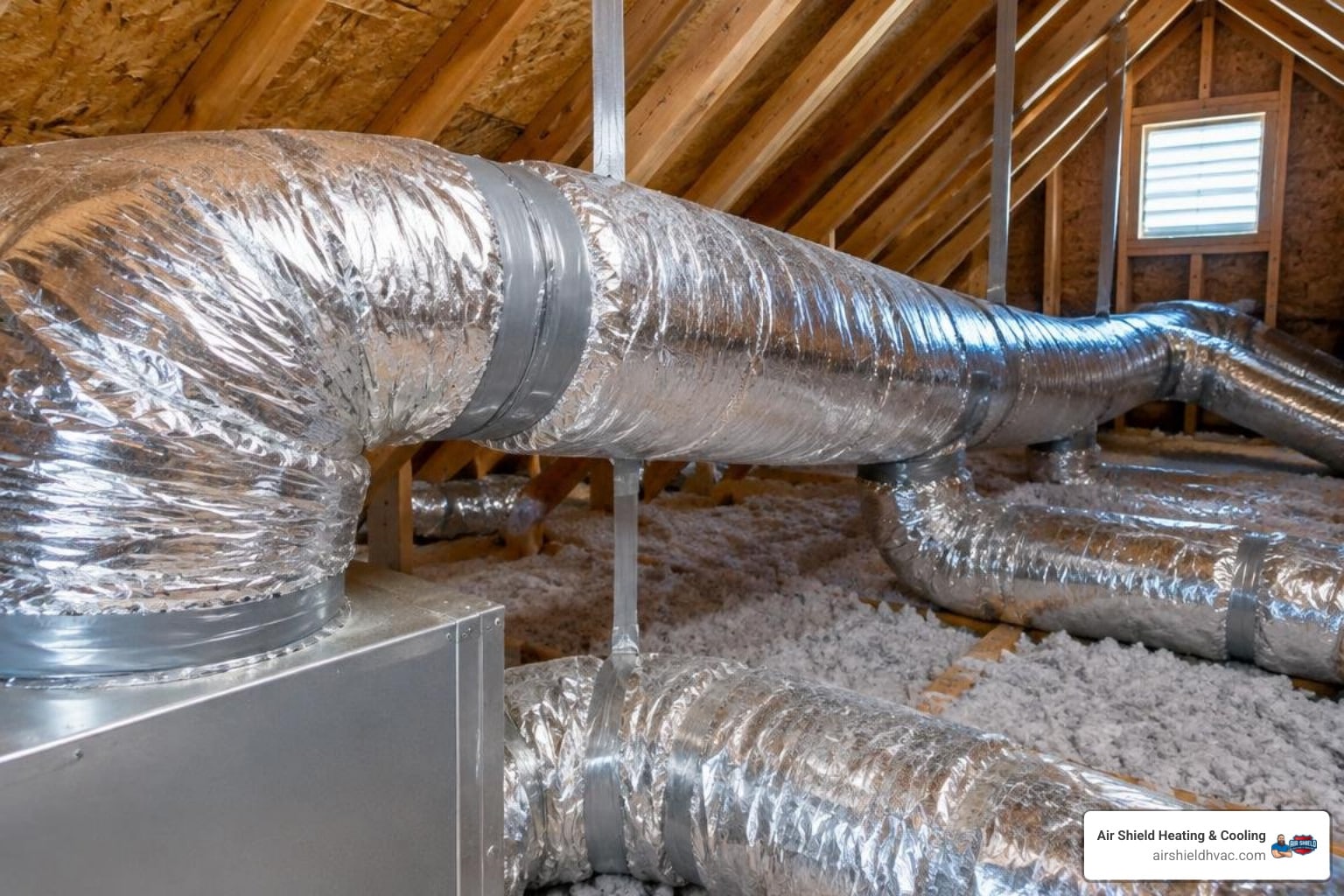
Living along the Suncoast means dealing with extreme humidity and baking attic temperatures for most of the year. Across Bradenton, FL, Sarasota, FL, Lakewood Ranch, FL, and nearby communities, the team often finds degraded, crushed, or missing duct insulation. Your sheet metal ductwork acts as the circulatory system of your home, and when its thermal barrier fails, your entire cooling setup suffers.
Several clear indicators reveal that your attic duct insulation requires attention. Duct checks that support better AC performance can help identify airflow concerns and mechanical wear before they worsen:
- Spiking energy bills during cooling months despite normal thermostat settings.
- Uneven room temperatures, where rooms furthest from the air handler stay warm and stuffy.
- Visible moisture or dripping water coming through your drywall ceilings.
- Weak airflow from your supply registers caused by compromised or deteriorating duct runs.
- Musty odors circulating through your living spaces when the AC kicks on.
If you suspect your duct system is leaking conditioned air into your attic space, discovering whether leaking air conditioning ductwork is driving up your bills is an important first diagnostic step. regular duct checks can verify system airflow, check static pressure, and identify mechanical wear early.
Thermal Loss and Attic Heat Gain
In places like Palmetto, FL, and Parrish, FL, unconditioned attic spaces routinely reach temperatures between 120°F and 140°F during summer afternoons. When your AC system produces cold, 55°F air and pushes it through sheet metal ducts surrounded by superheated attic air, a massive temperature difference occurs.
Without adequate thermal resistance, heat transfers into your supply air through both conductive heat transfer and radiant heat gain. By the time that cooled air reaches your bedrooms, its temperature may have climbed several degrees. This forces your compressor and blower motor to run extended cooling cycles, driving up power consumption and accelerating component wear.
Condensation, Duct Sweating, and Mold Growth
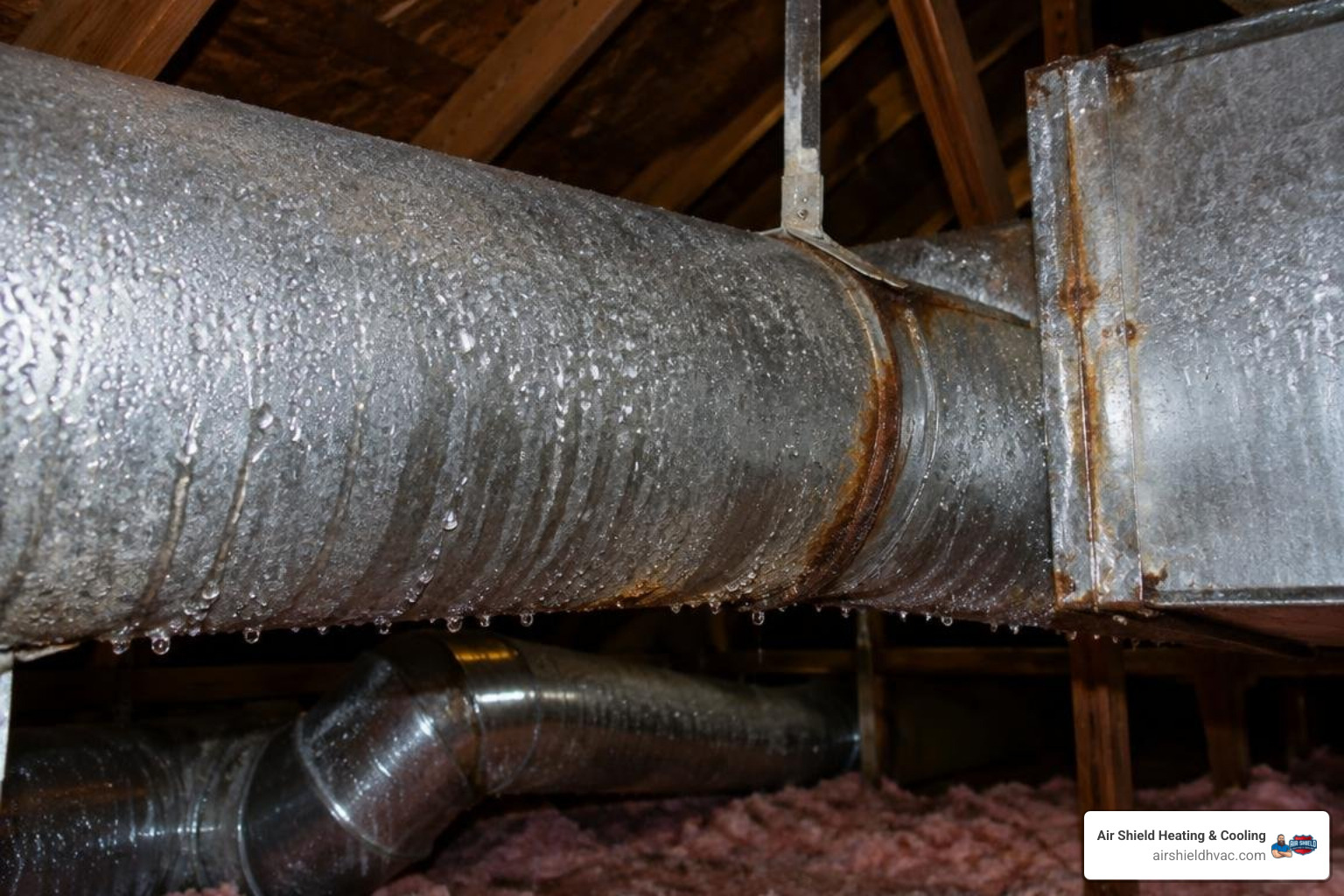
High humidity combined with extreme attic heat creates an ideal environment for condensation. When warm, humid air comes into direct contact with cold, uninsulated metal ductwork, the air drops below its dew point. Moisture immediately condenses on the metal surface, creating a condition commonly known as duct sweating.
This dripping water saturates ceiling drywall, damages attic framing, and degrades existing fiberglass batt insulation. Even worse, persistent moisture in a dark, warm attic encourages mold and mildew colonization. Setting up routine air duct maintenance in Bradenton, FL helps keep your duct surfaces dry, structurally sound, and free of organic contamination.
Comparing Duct Insulation Materials: Fiberglass, Reflective Foil, and Closed-Cell Foam
Choosing the right insulation wrap for ducting requires balancing thermal performance, space availability, vapor permeability, and fire safety ratings. In residential and light commercial HVAC applications across Manatee County, FL, three primary insulation materials dominate the market.
| Material Type | Typical Installed R-Value | Standard Thickness | Moisture & Vapor Barrier | Flame / Smoke Rating (ASTM E84) | Best Use Case |
|---|---|---|---|---|---|
| Fiberglass Duct Wrap (FSK Faced) | R-4.2 to R-8.0 | 1.5 in. to 3.0 in. | Reinforced Foil-Scrim-Kraft (0.02 perm) | 25 / 50 (Class A) | Standard attic supply and return trunk lines |
| Reflective Bubble Wrap | R-6.0 to R-8.0 (with air gaps) | 5/16 in. to 3/4 in. | Dual-layer metallized film (0.02 perm) | 25 / 50 (Class A) | Tight clearance chases and radiant heat barriers |
| Closed-Cell Elastomeric Foam | R-4.0 to R-8.0 | 0.5 in. to 2.0 in. | Inherent closed-cell (0.10 perm-inch) | 25 / 50 (Class A) | High-humidity zones and fiber-free environments |
Fiberglass duct wrap insulation with an integrated Foil-Scrim-Kraft (FSK) facing has a continuous service temperature limit of 250°F and is manufactured with a minimum of 50% recycled glass content. Standard fiberglass wrap densities average around 0.75 pounds per cubic foot, offering balanced flexibility and acoustic absorption to quiet noisy airflow.
Selecting the Right Ducting Insulation Wrap for Humid Climates
In Florida’s humid subtropical climate, your duct wrap must perform two critical jobs: resist conductive heat transfer and provide an absolute vapor barrier. If warm ambient moisture penetrates the outer jacket, condensation forms inside the insulation blanket, destroying its thermal value.
When selecting fiberglass duct wrap, look for products with factory-applied FSK or PSK (Polypropylene-Scrim-Kraft) jackets that feature a water vapor permeance rating of 0.02 perms or less. Modern light-density wraps frequently incorporate plant-based, formaldehyde-free binder technology, which eliminates harsh off-gassing and improves indoor air quality handling for installers and homeowners alike.
For thermal thickness selections, standard fiberglass wrap is available in:
- 1.5-inch thickness: Delivers an approximate out-of-package thermal performance of R-4.2 to R-5.1.
- 2.1875-inch (2-3/16″) thickness: Delivers an out-of-package performance of R-6.0.
- 3.0-inch thickness: Delivers an out-of-package performance of R-8.0.
Reflective Bubble Wrap vs. Blanket Insulation
Reflective bubble wrap insulation utilizes layers of polyethylene-encapsulated air bubbles faced with high-reflectance foil. Rather than relying purely on bulk fibrous mass to slow conductive heat transfer, reflective systems reflect up to 96% of radiant heat away from the ductwork.
However, reflective insulation relies heavily on proper spacing to achieve its advertised thermal rating. To achieve a true R-6.0 rating with standard reflective wrap, you must create a continuous 0.75-inch dead air space between the duct surface and the foil layer using dedicated spacer strips. Advanced multi-layer bubble products can achieve an R-8.0 rating with finished thicknesses around 11/16 to 3/4 inch when paired with manufacturer-approved spacers installed at 24-inch intervals.
Reflective wrap is clean to handle and does not shed fibers, but it has a lower surface temperature limit of 180°F compared to 250°F for FSK-faced fiberglass. In expansive, open attic spaces where clearance is not an issue, thick fiberglass wrap remains the standard choice for durable, long-term thermal resistance.
How to Properly Seal and Insulate Attic Ductwork
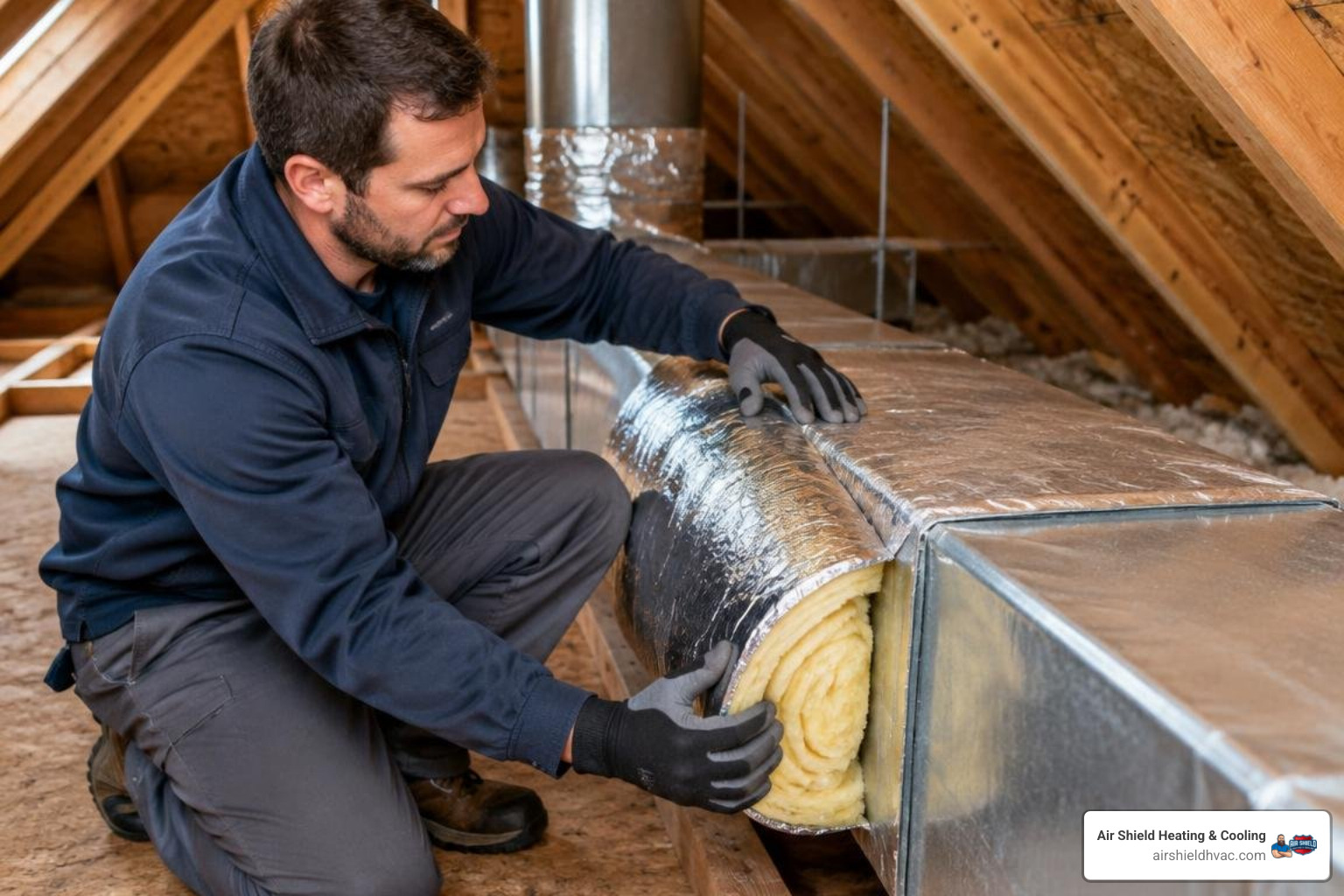
A common issue the team encounters is wrapping insulation directly over leaky ductwork. Insulation blanket material slows down heat transfer, but it cannot stop pressurized air leaks. If your metal joints leak cold supply air underneath the insulation, that air chills the outer jacket, causing moisture to condense and saturate the blanket from within. professional ductwork repair and installation can address leaking joints before new insulation is applied.
Before applying any wrap, every longitudinal seam, transverse joint, fitting transition, and take-off collar must be mechanically fastened and sealed airtight. Reviewing proven methods for repairing air ducts will help you identify cracked joints and failing tape before starting your insulation project.
For complex attic configurations across Sarasota County, FL, or Manatee County, FL, professional custom transitions make a substantial difference. Following structural guidelines for HVAC ductwork installation ensures your duct system maintains optimal static pressure and airtight performance for decades.
Step-by-Step Installation of Ducting Insulation Wrap
Applying ducting insulation wrap requires precision, clean cuts, and continuous vapor sealing. If you plan to tackle this project yourself, always wear protective gloves, safety glasses, long sleeves, and an N95 respirator when working in confined, hot attics.
Here is the essential toolkit required for a clean installation:
- Heavy-duty fiberglass duct knife or sharp utility blade
- Outward-clinch plier stapler with compatible 0.5-inch outward-clinching staples
- UL 181A-P or UL 181B-FX rated aluminum foil tape (minimum 2.5 to 3 inches wide)
- Plastic squeegee or nylon tape burnishing tool
- Perforated base or self-sticking mechanical insulation pins with locking washers
- 18-gauge galvanized tie wire (for round duct support)
- Tape measure and framing square
Follow these steps to wrap your sheet metal duct runs:
- Clean and Prepare the Duct Surface: Wipe down all exterior metal surfaces with a clean, dry shop cloth to remove construction dust, oil, and loose debris.
- Seal All Air Leaks: Apply fiber-reinforced water-based mastic sealant or UL 181-approved foil tape across all metal joints, screws, and seams. Allow the mastic to cure completely before proceeding.
- Calculate the Perimeter Stretch-Out: Measure your duct accurately to avoid over-compressing the fiberglass. For round ducts, calculate the required cut length using plain arithmetic: add the outer duct diameter to twice the nominal insulation thickness, then multiply that total by 3.14 (pi). Add 2 inches to this cut length to create an overlapping stapling tab. For rectangular ducts, add the width and depth, multiply by 2, and add 6 to 8 inches for perimeter corner allowance.
- Prepare the Overlap Flange: Cut through the fiberglass core using your duct knife, then carefully peel away a 2-inch strip of fiberglass from the end of the blanket without cutting the underlying foil jacket. This creates an integrated vapor barrier stapling flange.
- Wrap and Staple: Wrap the insulation blanket snugly around the ductwork with the foil facing outward. Overlap the 2-inch foil tab over the adjacent edge and secure it with outward-clinch staples spaced approximately 6 inches apart.
- Vapor Seal Every Seam: Apply 3-inch wide UL 181-rated aluminum foil tape centered over every longitudinal and circumferential joint. Use your plastic squeegee to firmly burnish the tape from the center outward, eliminating air pockets and activating the pressure-sensitive acrylic adhesive.
- Secure Underside of Wide Ducts: For rectangular ducts wider than 24 inches, gravity causes the bottom span of the insulation to sag away from the metal. Install self-adhesive mechanical stick pins spaced on 18-inch centers along the bottom face, press the insulation over the pins, and secure them with locking washers. Be careful not to push the washers too tightly, which would crush the fiberglass.
Safety and Professional Service Reminder: Working inside an unconditioned Florida attic involves intense heat stress, low visibility, narrow ceiling joists, and electrical hazards. If you encounter deteriorated duct board, structural obstacles, or severe mold growth, or if you feel uncertain about achieving an airtight vapor barrier, stop and contact a licensed professional HVAC contractor immediately.
Critical Installation Mistakes That Ruin Efficiency
Even high-quality insulation materials fail if installed incorrectly. These common installation mistakes undermine system efficiency:
- Excessive Material Compression: When fiberglass wrap is pulled too tightly around sheet metal or bound tightly with wire, its thickness decreases. Fiberglass relies on trapped air pockets to insulate; crushing a 3-inch R-8 blanket down to 1.5 inches cuts its effective thermal resistance nearly in half. Standard industry calculations assume a maximum 25% compression factor during installation.
- Unsealed Vapor Barrier Punctures: Leaving stapled seams untaped or ignoring small tears in the foil facing allows humid attic air to touch the cold metal inside, leading to hidden mold and rotting insulation.
- Compressing Wrap with Hanging Straps: When sheet metal ducts rest on narrow metal hanger straps, wrapping the insulation over the straps crushes the blanket at every support point. Instead, support the duct properly and place rigid insulation saddles or spacer blocks beneath the ductwork to prevent localized thermal bridging.
- Skipping Mechanical Air Sealing: Never use duct wrap as a patch over leaking metal seams. Always apply mastic and approved tape directly to the bare sheet metal before wrapping. The official DOE building science guidelines for insulated metal ducts emphasize that thermal insulation and airtight mechanical seals must operate as two distinct, high-performance layers.
Florida Building Codes, R-Value Standards, and Safety Compliance
Duct insulation standards in Florida are governed by the Florida Building Code (Energy Conservation). Because attic temperatures in places like Sun City Center, FL, Ellenton, FL, and Ruskin, FL, are exceptionally high, building codes mandate minimum thermal resistance levels to curb regional energy waste.
Under current Florida energy codes:
- Supply and return ducts located in unconditioned spaces (such as vented attics) must achieve a minimum thermal resistance of R-6, with R-8 widely mandated for new residential construction and substantial duct replacements.
- Ducts located within the conditioned building envelope (such as between intermediate floors or dropped chases) typically require a minimum of R-4.2.
Beyond thermal performance, safety compliance is non-negotiable. All duct wrap materials installed in residential or commercial buildings must meet ASTM C1290 (Standard Specification for Flexible Fibrous Glass Blanket Insulation Used to Externally Insulate HVAC Ducts) and ASTM E84 / UL 723 surface burning characteristics. This standard requires a Flame Spread Index of 25 or less and a Smoke Developed Index of 50 or less, classifying the wrap as Class A fire-rated.
Properly insulating and sealing your duct system protects your family, maintains code compliance, and ensures that clean, filtered air moves efficiently through your home. To learn how clean, sealed, and properly insulated ducts improve everyday system reliability, check out these insights on the benefits of cleaner and insulated ducts.
Frequently Asked Questions About Attic Duct Wrap
What is duct wrap insulation and what is its primary purpose?
Duct wrap insulation is a flexible thermal blanket, typically composed of fiberglass, closed-cell foam, or reflective bubble wrap with an external vapor retarder facing. Its primary purpose is to slow conductive and radiant heat transfer into conditioned airflow and prevent moisture condensation from forming on cold sheet metal surfaces located in unconditioned spaces.
What R-value is required for attic ductwork in Florida?
In Florida, building energy codes mandate a minimum of R-6 insulation on HVAC ductwork located in unconditioned attics, while R-8 is the standard requirement for new construction and complete duct replacement projects in vented attic spaces.
What is the difference between fiberglass duct wrap and reflective bubble wrap?
Fiberglass duct wrap relies on bulk fibrous density and trapped air pockets to resist conductive heat flow across a 1.5- to 3-inch blanket thickness. Reflective bubble wrap uses metallized surfaces to reflect radiant heat away from the duct and requires an engineered 0.75-inch sealed air gap to achieve an equivalent R-6 or R-8 rating.
How does compression affect the R-value of fiberglass duct wrap?
Compressing fiberglass insulation reduces the volume of dead air trapped between the glass fibers, directly lowering its thermal resistance. Installing a fiberglass blanket under excessive tension can drop an out-of-package R-8.0 rating down to R-6.0 or lower.
Why is an airtight vapor barrier essential on air conditioning ducts?
In humid climates, cold air conditioning ducts drop the surrounding air below its dew point. An airtight vapor barrier with a permeance rating of 0.02 perms or less prevents ambient moisture from contacting the cold duct surface, stopping condensation, rust, water damage, and mold growth.
What tools are required to install duct wrap insulation?
Installing duct wrap requires a specialized duct knife, an outward-clinch plier stapler with 0.5-inch staples, UL 181-rated aluminum foil tape, a plastic tape squeegee, mechanical stick pins with locking washers, galvanized tie wire, and protective equipment including gloves, safety glasses, and an N95 respirator.
How do you calculate the correct wrap length for round sheet metal pipes?
To calculate the wrap length for a round duct, add the outer diameter of the metal pipe to twice the insulation thickness, multiply that sum by 3.14 (pi), and add 2 inches for the overlap stapling flange.
Can you install duct wrap over leaking ductwork?
No, you should never wrap leaking ductwork. Pressurized air escaping from unsealed joints will chill the insulation from underneath and cause heavy condensation inside the blanket. All joints must be sealed with mastic or UL 181-rated tape before applying wrap.
How do you prevent insulation from sagging on large rectangular ducts?
On rectangular ducts wider than 24 inches, secure the bottom span of insulation using self-adhesive mechanical stick pins and locking washers spaced across 18-inch centers to prevent gravity from pulling the wrap away from the sheet metal.
How long does duct insulation wrap last in an unconditioned attic?
Quality fiberglass duct wrap with an intact vapor barrier can last 15 to 20 years. However, high attic heat, roof leaks, high humidity, insect or rodent activity, and physical crushing can degrade the material much earlier, requiring inspection or replacement.
Conclusion
Upgrading degraded or under-insulated ductwork in your attic is one of the most effective ways to lower summer utility bills, eliminate hot spots, and protect your home from moisture damage and mold. Properly sealed sheet metal combined with code-compliant R-8 duct wrap ensures that every cubic foot of chilled air paid for reaches your living spaces at the right temperature.
If your home in Bradenton, FL, Sarasota, FL, Lakewood Ranch, FL, or surrounding Suncoast communities struggles with uneven cooling, high energy bills, or sweating attic ducts, our experienced team at Air Shield Heating & Cooling is here to help. Contact our professional ductwork repair technicians today.