
What to Do When Your AC Stops Blowing Cold Air
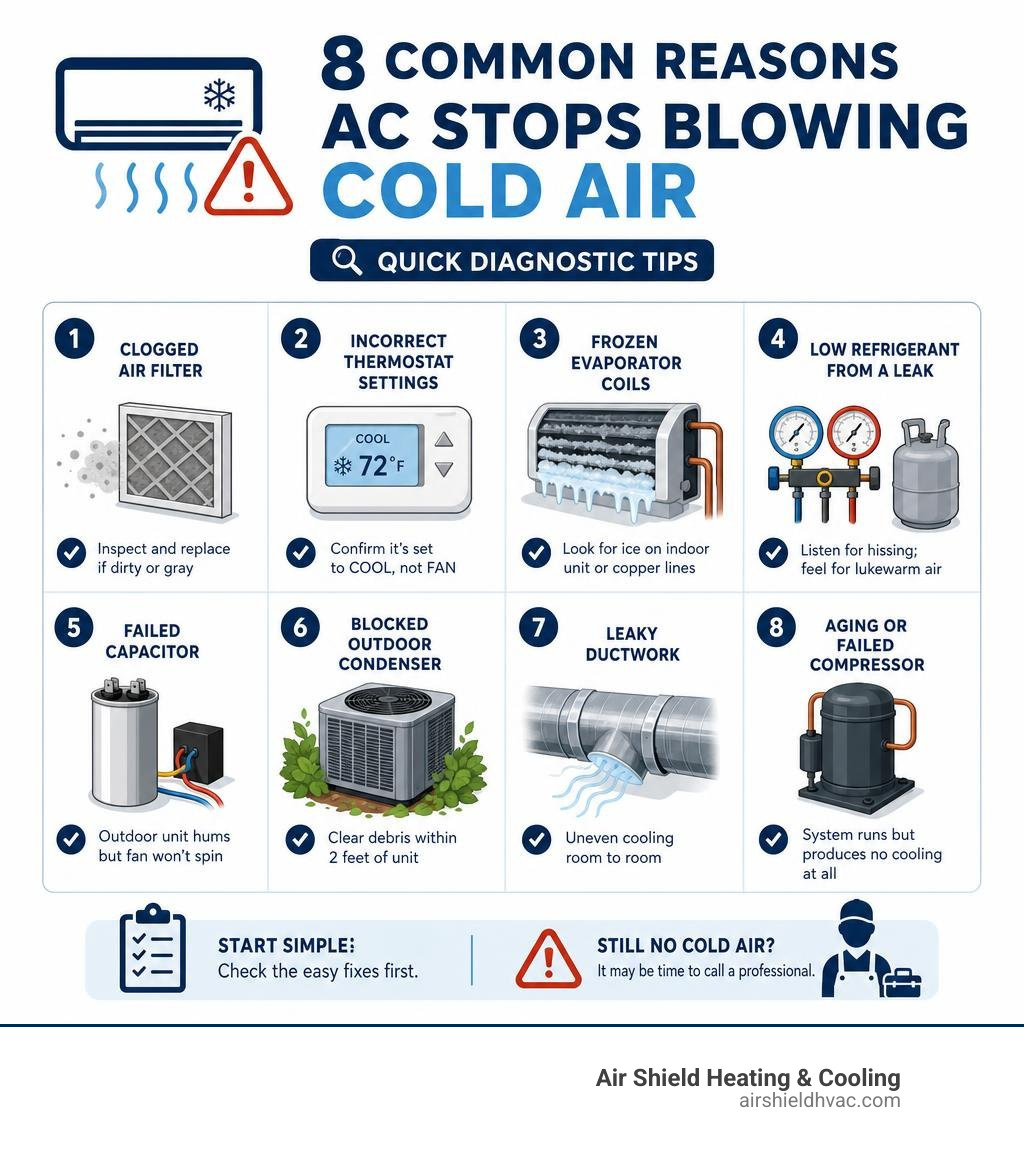
If your AC is not blowing cold air, here are the most common reasons why it happens:
| Cause | Quick Check |
|---|---|
| Clogged air filter | Inspect and replace if dirty or gray |
| Incorrect thermostat settings | Confirm it’s set to COOL, not FAN |
| Frozen evaporator coils | Look for ice on the indoor unit or copper lines |
| Low refrigerant from a leak | Listen for hissing; feel for lukewarm air |
| Failed capacitor | Outdoor unit hums but fan won’t spin |
| Blocked outdoor condenser | Clear debris within 2 feet of the unit |
| Leaky ductwork | Uneven cooling room to room |
| Aging or failed compressor | The system runs but produces no cooling at all |
There is nothing quite like walking into your home on a sweltering Florida afternoon, expecting a cool rush of air, only to find your AC not blowing cold air and the thermostat reading 82 degrees. For homeowners in Manatee County, FL, where summer heat and humidity push systems to their limits for months at a time, a cooling failure is not just uncomfortable. It can quickly become a health concern for families, elderly residents, and pets.
The frustrating part is that an AC that runs but does not cool is not always a sign of a major breakdown. In fact, roughly half of all “not cooling” service calls turn out to have a simple fix, like a clogged air filter or a thermostat set to the wrong mode. But other causes, like a refrigerant leak or a failing compressor, do require professional attention, and running your system in that condition can turn a manageable repair into a much more expensive one.
Understanding what is actually happening inside your system when cold air stops coming through the vents helps you respond quickly and make smart decisions about next steps.
Air Shield Heating & Cooling has over two decades of hands-on HVAC experience diagnosing and resolving cases of AC not blowing cold air across Manatee County and nearby Florida communities. In this guide, we will walk you through the eight most common causes, what to check yourself, and when it is time to pick up the phone.
Troubleshooting an AC Not Blowing Cold Air: 8 Common Causes
When your home cooling system stops performing, it is helpful to look at it as a chain of events. Your air conditioner does not actually “create” cold air. Instead, it works by extracting heat and humidity from your indoor air and moving it outside. This process relies on continuous airflow, a functioning refrigeration cycle, and precise electrical timing.
If any link in this chain breaks, the cooling process stops, even though your indoor fan might keep running and blowing warm or room temperature air. To help you understand what might be happening, I recommend reviewing this professional Carrier guide on AC not blowing cold air which outlines how these systems behave during a malfunction.
By understanding how these components interact, you can better identify the root cause of the issue. I have put together some essential tips on why your AC isn’t cooling properly to help you navigate the initial stages of troubleshooting. Let us dive into the eight most common culprits behind a sudden loss of cooling.
1. Clogged Air Filter Restricting Airflow
A dirty or clogged air filter is the most frequent reason an air conditioner stops cooling. It is a simple component, but it plays a critical role in maintaining the necessary airflow across your indoor evaporator coil.
When the filter becomes packed with dust, pet dander, and local Florida pollen, it creates severe airflow restriction. Without enough warm air passing over the cold evaporator coil, the refrigerant inside the coil cannot absorb heat effectively. This causes the temperature of the coil to drop below freezing, leading to moisture on the coil turning into ice. Once the coil freezes, it completely blocks any remaining air from passing through, and your system will start blowing warm air or stop blowing air altogether.
Over time, the dust that escapes a clogged filter can also accumulate inside your ductwork and on other internal components, further reducing system efficiency. If you notice persistent dust issues or weak airflow even after changing your filter, it might be a sign of deeper build-up in your system. Homeowners can look out for specific signs you need air duct cleaning in Bradenton, FL to keep their indoor air quality and system performance in top shape.
2. Low Refrigerant Levels from a Leak
Refrigerant is the chemical lifeblood of your cooling system. It continuously circulates between the indoor and outdoor units, changing from a liquid to a gas to absorb and release heat.
A common misconception is that air conditioners “use up” refrigerant over time, similar to gasoline in a car. In reality, your AC is a closed, pressurized system. If your refrigerant levels are low, it always indicates a refrigerant leak.
When a leak occurs, the lower pressure causes the evaporator coil to run much colder than designed, which frequently leads to ice buildup. You might also hear a distinct hissing or bubbling sound near the indoor unit or the outdoor copper lines. Due to environmental regulations and EPA guidelines, diagnosing and repairing refrigerant leaks requires specialized tools and certified technicians. Topping off the system without fixing the actual leak is a temporary, expensive mistake that can eventually ruin your compressor.
3. Frozen Evaporator Coils Blocking Heat Transfer
As mentioned, frozen evaporator coils are usually a symptom of another underlying issue, typically restricted airflow or low refrigerant. When ice forms on the indoor coil, it acts as an insulating barrier, preventing the refrigerant from absorbing heat from your home.
If you suspect your coils are frozen, you will need to turn your system off immediately to let the ice melt. Running the system with frozen coils puts immense strain on the compressor, which can lead to permanent mechanical failure. Melting a fully frozen coil can take anywhere from a few hours to a full day. Once the system has completely thawed, a technician can safely perform diagnostics to identify what caused the freeze in the first place. Knowing what AC repair fixes first can help you understand the diagnostic steps a professional will take to resolve a frozen system.
4. Thermostat Settings Causing Your AC Not Blowing Cold Air
Sometimes the solution to a warm house is as simple as a misplaced setting on your wall. Thermostats can easily be bumped, or family members might adjust settings without everyone knowing.
The first thing to check is the fan mode. If your thermostat fan is set to ON, the indoor blower fan will run continuously, even when the outdoor cooling unit is turned off. This means the system will blow unconditioned, room temperature air through your vents between cooling cycles, making it feel like your AC is failing. Switching the fan mode to AUTO ensures the fan only blows when the system is actively cooling. You should also check for low batteries or calibration issues, especially on older digital models.
5. Failed Capacitor or Electrical Issues
Your outdoor unit relies on several electrical components to run the fan and the compressor. The most common electrical failure we see during hot Florida summers is a failed capacitor.
A capacitor acts like a small, short term battery that provides the high voltage boost required to start up the compressor and the outdoor fan motor. Because of the intense heat in areas like Bradenton, FL and Sarasota, FL, capacitors are under constant thermal stress and frequently fail. In fact, capacitor failure accounts for 25 to 30 percent of summer emergency AC service calls.
When a capacitor fails, you might hear a low humming or buzzing sound coming from the outdoor unit, but the fan blades will not spin and the compressor will not start. If you notice these symptoms, it is important to shut the system down to prevent the motors from overheating. Listening to these changes in system behavior is crucial, and understanding why your AC is making strange noises can help you prevent a minor electrical issue from turning into a costly motor replacement.
6. Blocked or Dirty Outdoor Condenser Unit
The outdoor unit, or condenser, is responsible for releasing the heat that was captured inside your home. To do this efficiently, the condenser coils must be clean, and there must be plenty of open space around the cabinet for proper heat dissipation.
Over time, the metal fins on the outdoor unit can become coated with dirt, lawn clippings, leaves, and salt air residue, which is especially common in coastal communities like Bradenton Beach, FL and Holmes Beach, FL. When these coils are blocked, the heat remains trapped inside the system, causing the compressor to run hotter and lose its cooling capacity. Keeping a clear two foot perimeter around the outdoor unit and gently rinsing the coils with a garden hose can make a massive difference in performance.
7. Damaged or Leaky Ductwork
You could have a perfectly functioning AC unit, but if the distribution system is compromised, you will still end up with a warm house. Your ductwork is the pathway that carries conditioned air to your rooms and returns warm air to the system.
According to the Department of Energy, typical homes lose 20 to 30 percent of conditioned air through duct leaks. In Florida, ductwork is usually run through hot attics. If a duct connection becomes loose or tears, your AC will blow cold air directly into your attic while pulling hot, dusty attic air into your living spaces. This leads to uneven cooling, high utility bills, and a system that constantly struggles to lower the indoor temperature.
8. Aging Compressor Leading to AC Not Blowing Cold Air
The compressor is often referred to as the heart of your AC system. It is the pump that compresses the refrigerant gas and circulates it through the system.
As an AC unit ages, the internal valves and seals of the compressor can wear down, reducing its ability to pump refrigerant effectively. If the compressor fails completely, the refrigeration cycle stops entirely, and your system will only circulate warm air. Because the compressor is the most expensive component to replace, its failure on an older system often means it is time to consider a full system replacement rather than a repair.
Quick DIY Checks to Try Before Calling a Professional

Before you pick up the phone to call for service, there are a few safe, simple checks you can perform. These quick steps can save you the time and expense of a professional service visit for an issue you can easily resolve yourself.
- Verify Thermostat Settings: Make sure the thermostat is set to COOL and the temperature setting is at least 3 to 5 degrees below the current room temperature. Ensure the fan setting is on AUTO.
- Check the Air Filter: Pull out your air filter and hold it up to a light source. If you cannot see light passing through it, replace it immediately.
- Inspect the Circuit Breakers: Check your home’s main electrical panel and the outdoor disconnect box. If a breaker has tripped, reset it once. If it immediately trips again, do not attempt to reset it a second time, as this indicates a serious electrical fault.
- Examine the Outdoor Unit: Visually inspect the outdoor condenser. Ensure there are no weeds, bushes, or stored items blocking airflow within two feet of the unit.
- Check the Air Vents: Walk through your home and ensure that your supply registers and return grilles are open and completely unobstructed by furniture or drapes.
If you have completed these steps and your home is still not cooling down, you can refer to our detailed AC troubleshooting guide for additional help, or prepare to contact a professional technician for a proper diagnostic evaluation.
When to Turn Off Your System and Call for Emergency AC Repair
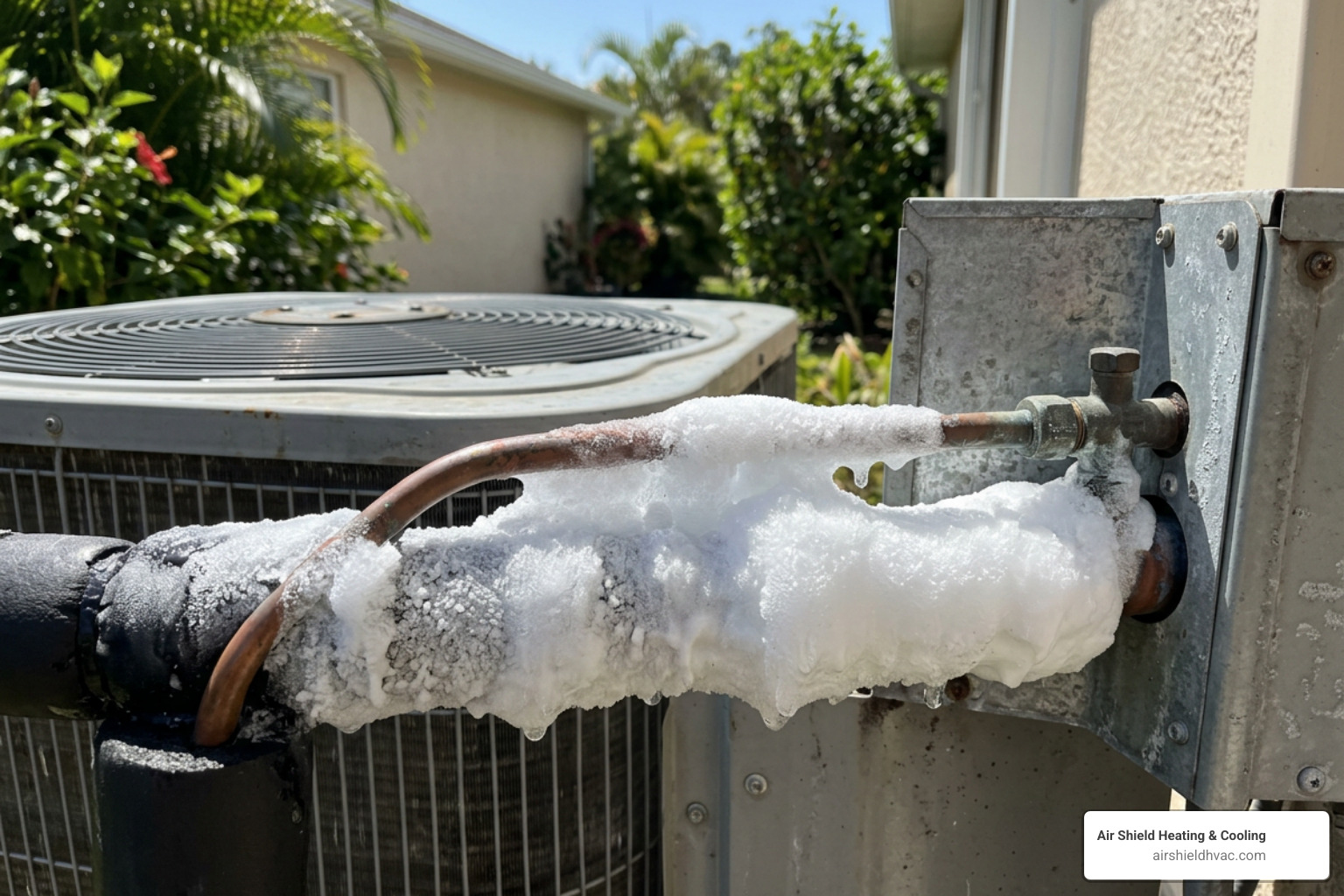
There are several scenarios where continuing to run a malfunctioning air conditioner will cause extensive, irreversible damage to expensive components. If you notice any of the following warning signs, turn your system off at the thermostat immediately and contact us for professional assistance.
- Visible Ice Buildup: If you see ice forming on the outdoor copper refrigerant lines or covering the indoor evaporator coil, turn the system off. Running it with ice can liquid lock the compressor, destroying it.
- Hissing or Bubbling Noises: These sounds usually point to a high pressure refrigerant leak, which requires immediate attention to protect the system and the environment.
- Electrical Burning Odors: If you smell a metallic, plastic, or electrical burning scent coming from your vents or the outdoor unit, shut off the power at the main breaker panel immediately.
- Rapid System Short Cycling: If your AC turns on and off every few minutes, it is experiencing extreme stress that can quickly burn out the compressor and fan motors.
- The Outdoor Unit is Humming but Not Running: This indicates a failed capacitor or seized motor. Leaving the power on will cause the motor winding to overheat and fail.
For situations like these, our team provides rapid emergency AC repair services throughout Manatee County, FL to restore your comfort and protect your equipment from further damage.
Repair vs. Replace: Deciding the Future of Your Cooling System
When faced with a major repair on an older system, one of the toughest decisions homeowners face is whether to invest in repairs or replace the unit entirely.
In coastal Florida, the harsh environment of salt air, high humidity, and intense heat means that the average lifespan of an AC unit is typically 10 to 12 years, compared to the national average of 15 years.
| Factor | Consider Repair | Consider Replacement |
|---|---|---|
| System Age | Under 8 years old | Over 10 to 12 years old |
| Repair Cost | Less than 50% of system value | Exceeds 50% of a new system’s cost |
| Refrigerant Type | Uses modern R-410A or newer | Uses obsolete, expensive R-22 |
| System History | Reliable with few past issues | Frequent breakdowns and high utility bills |
| Efficiency Needs | Satisfied with current bills | Looking to reduce energy use by 20% to 40% |
If your system is relatively young and the issue is a failed capacitor or dirty coil, a professional air conditioning repair is almost always the smartest choice. However, if you are facing a failed compressor on a 12 year old system, investing in a modern, high efficiency replacement will save you more money in the long run through reduced energy bills and the peace of mind of a new manufacturer warranty.
Frequently Asked Questions About an AC Not Blowing Cold Air
Why is my AC running but not blowing cold air?
This occurs when the indoor blower motor is working, but the refrigeration cycle has been interrupted. The most common causes include a failed capacitor preventing the outdoor compressor from starting, a refrigerant leak, an extremely dirty air filter blocking airflow, or a blocked outdoor condenser unit that cannot release heat.
Can a dirty air filter cause my AC to stop cooling?
Yes, a dirty air filter is the most common cause of cooling failures. It severely restricts airflow, which starves the evaporator coil of the warm air it needs to function. This causes the coil temperature to drop, leading to frozen coils, restricted heat transfer, and system overheating.
Should I turn off my AC if it is blowing warm air?
Yes, you should turn the system off immediately. If the system is blowing warm air due to a frozen coil or low refrigerant, continuing to run it puts immense thermal and mechanical strain on the compressor, which can lead to permanent damage and a much more expensive replacement.
How do I reset my central AC unit?
To safely reset your system, turn the thermostat to the OFF position. Go to your home’s main electrical panel and locate the circuit breaker for your AC. Flip the breaker to the OFF position, wait five full minutes, and then flip it back to ON. Finally, set your thermostat back to COOL and set the temperature.
How do I know if my AC has a refrigerant leak?
Common signs of a refrigerant leak include a gradual loss of cooling capacity over several weeks, lukewarm air coming from the vents, hissing or bubbling sounds near the indoor or outdoor units, ice forming on the copper refrigerant lines, and oily residue around the refrigerant line connections.
Why is my AC blowing cold air at first and then warm air?
This symptom usually indicates a freezing evaporator coil. When you first turn the system on, the coil is clear of ice and cools the air. However, due to restricted airflow or low refrigerant, moisture quickly freezes on the coil, blocking airflow and heat transfer, which causes the air to become warm.
How often should I replace my home air filters?
In Florida, where systems run constantly for most of the year, we recommend checking your air filters monthly. For standard one inch pleated filters, replace them every 30 to 90 days. If you have pets, allergies, or live in a high dust area, you should replace them closer to the 30 day mark.
Can leaky ductwork prevent my home from cooling evenly?
Yes. If your ductwork has leaks, tears, or disconnected sections, a significant portion of your conditioned air will escape into your hot attic instead of reaching your living spaces. This causes uneven temperatures, high energy bills, and forces your system to run longer to keep up.
How long does it take for an AC to start blowing cold air?
Once a properly functioning AC system cycles on, you should begin to feel noticeably cool air coming from your supply vents within 5 to 15 minutes. It takes a few minutes for the compressor to establish the proper operating pressures and for the indoor coil to reach its cooling temperature.
Is it better to repair or replace a ten year old AC in Bradenton, FL?
Because of our coastal salt air and extended cooling seasons, a ten year old system is nearing the end of its reliable lifespan. If the repair is minor, like a capacitor, repairing it makes sense. If it requires a major repair like a compressor or coil, replacement is usually the more cost effective long term choice.
Conclusion
Dealing with an AC not blowing cold air during a Florida summer is an experience every homeowner wants to avoid. Fortunately, by staying on top of simple tasks like regular filter changes and keeping your outdoor unit clear of debris, you can prevent the vast majority of common cooling failures.
For the more complex issues, like electrical failures, frozen coils, or refrigerant leaks, having a trusted local professional on your side makes all the difference. At Air Shield Heating & Cooling, we have spent over a decade keeping families comfortable across Bradenton, FL, Sarasota, FL, and the rest of Manatee County, FL with reliable, honest HVAC service.
Whether you need a quick diagnostic check, emergency repairs, or a seasonal tune-up to prevent future breakdowns, our family-owned team is here to help. Contact our HVAC professionals today to schedule professional HVAC service and bring cool comfort back to your home.