What to Do When Your AC Stops Working: Start Here
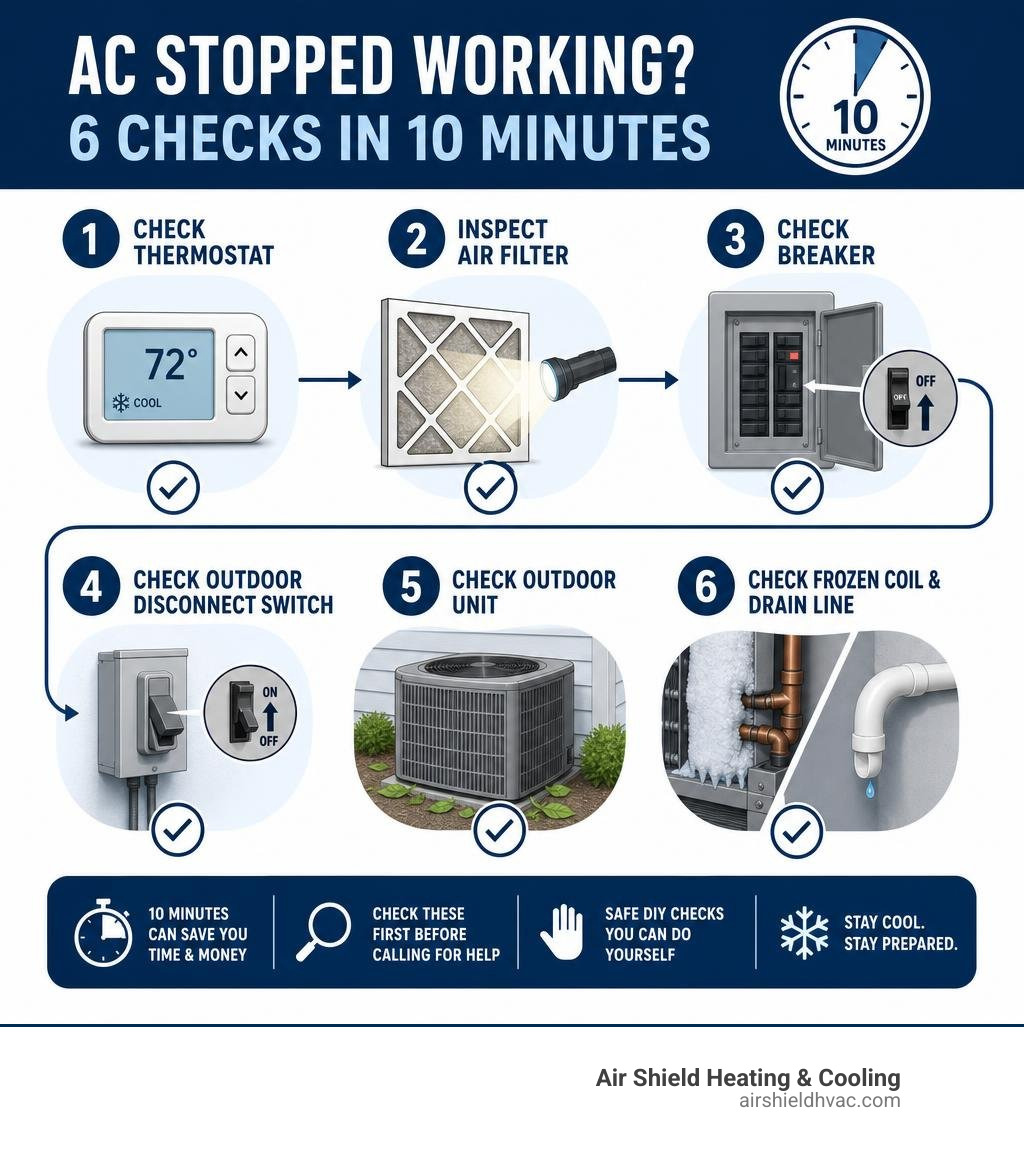
If your AC stopped working and you’re not sure what to do, here are the six things to check right now before calling a technician:
- Check the thermostat: Make sure it’s set to Cool mode and the target temperature is at least 3 to 5 degrees below the current room temperature. Replace the batteries if the screen is blank.
- Inspect the air filter: Hold it up to a light source. If you can’t see light through it, replace it immediately.
- Check the circuit breaker: Look for a tripped breaker in your electrical panel and reset it once if needed. Do not keep resetting it if it trips again.
- Check the outdoor disconnect switch: A switch near your condenser unit may have been accidentally switched off.
- Look at the outdoor condenser unit: Clear any debris blocking airflow and check that the fan is spinning.
- Check for a frozen evaporator coil: Look for frost on the refrigerant lines near the indoor unit. If you see ice, turn the system off and run the fan only to let it thaw.
It’s the middle of a sweltering Florida summer, and your AC stopped working. The house is getting warmer by the minute, the humidity is climbing, and you’re not sure whether to call a technician right away or try to fix it yourself first. That moment of uncertainty is exactly what this guide is here to resolve.
The good news is that many emergency AC service calls turn out to be caused by simple issues like a wrong thermostat setting or a clogged air filter, things you can check and fix yourself in under 10 minutes at no cost. A dirty air filter is one of the most common causes of AC problems, and it’s also one of the easiest fixes. Before you schedule a service call, it’s worth spending a few minutes working through the basics.
That said, some AC failures do require a licensed professional, and knowing the difference can save you from making a minor problem significantly worse. This guide walks you through both sides of that equation clearly and in order.
At Air Shield Heating & Cooling, our team has spent years helping Florida homeowners figure out exactly what to do when their AC stopped working, from quick DIY fixes to knowing when to call for backup. Let’s start with the checks that take five minutes or less.
AC Stopped Working What to Do: The Initial 5-Minute Checklist
When the indoor climate begins to resemble a tropical rainforest, it is easy to panic. However, taking a deep breath and performing a rapid visual assessment can save you both time and money. Many emergency service calls in places like Bradenton, FL and Sarasota, FL could have been avoided if the homeowner had run through a quick diagnostic routine first.
Before picking up the phone, our team recommends taking five minutes to check the absolute basics of your power supply and system settings. These are the same first steps many homeowners can safely take before deciding whether professional AC repair is needed.
By starting with a logical checklist, you can systematically rule out the most common non-technical issues. Let us break down the first three critical checks you can perform safely on your own.
1. Verify Thermostat Settings and Power
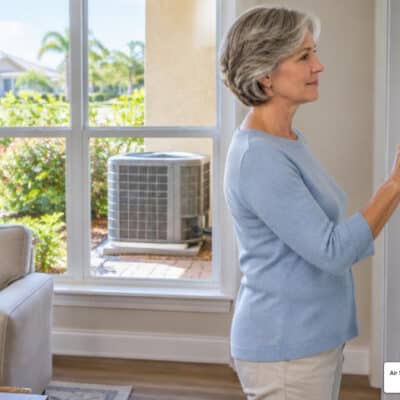
Your thermostat is the brain of your entire cooling system. If it loses power or has the wrong settings, your system will remain completely unresponsive.
First, look closely at the display. Is the screen completely dark? A blank LCD screen usually indicates that your thermostat batteries have died. Most modern programmable and smart thermostats rely on AA or AAA batteries to retain their settings and communicate with your indoor air handler. Pop the thermostat faceplate off the wall and replace the batteries with fresh ones.
If the screen is active, check the operating mode. It sounds incredibly simple, but household members occasionally bump the controls, switching the system to Heat or Fan Only mode. Ensure the system is firmly set to Cool.
Next, examine the setpoint temperature. The target temperature must be set at least 3 to 5 degrees below the current room temperature to signal the system to turn on.
Finally, if you use a smart thermostat, verify that it is still connected to your home Wi-Fi network. A sudden network drop can sometimes cause a smart thermostat to default to an idle state, leaving your home without active cooling.
2. Inspect the Air Filter for Clogs
If your thermostat checks out but your home still feels like an oven, your air filter is the very next place to look. A heavily clogged air filter is one of the most common causes of system issues.
When an air filter accumulates too much dust, pet dander, and debris, it restricts the volume of air passing through your system. This restriction causes a significant drop in static pressure. Without adequate airflow over the indoor evaporator coil, the coil cannot absorb heat effectively. This lack of heat transfer causes the temperature of the coil to drop below freezing, leading to ice buildup that completely blocks any remaining airflow.
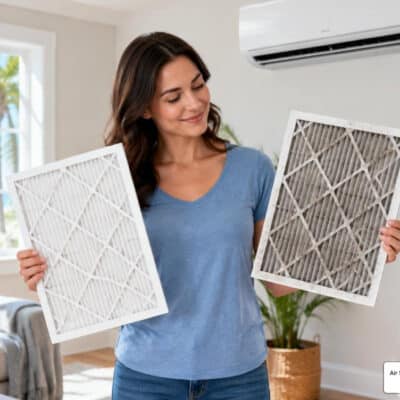
To determine if your filter is the culprit, slide it out of its slot and hold it up to a nearby light source. If you cannot see light passing through the fibers, the filter is choked with debris and must be replaced immediately. If airflow still feels weak after a clean filter is installed, Air Shield Heating & Cooling can help with air conditioning repair that identifies the deeper cause without guessing.
3. Check the Circuit Breaker and Disconnect Switch
Your cooling system relies on a substantial amount of electrical power, which is split across two separate circuits. One circuit powers your indoor air handler or furnace, while a completely separate, higher-voltage circuit powers your outdoor condenser unit.
Walk over to your home electrical panel and locate the breakers labeled for your AC or HVAC system. Look for any switch that has moved to the middle position or is completely flipped to the Off position. If you find a tripped circuit breaker, flip it firmly to the Off position first, then flip it back to the On position.
Additionally, you must check the outdoor disconnect switch, which is typically housed in a small weatherproof metal box mounted on the exterior wall near your outdoor unit. Inside this box, you will find either a pull-out switch or a large toggle switch. Sometimes, during heavy windstorms, yard work, or exterior home cleaning, this switch can accidentally be flipped or dislodged.
Electrical safety is paramount. If you reset a tripped breaker and it immediately snaps back to the tripped position, do not attempt to reset it again. A breaker that trips repeatedly is a clear warning sign of a short circuit or a serious electrical fault within the compressor or fan motor. Repeatedly forcing a tripped breaker to reset can result in permanent equipment damage or an electrical fire hazard.
Advanced Troubleshooting for Your Home Cooling System
If the basic checks did not restore your cool air, it is time to move on to slightly more advanced troubleshooting. These steps require a bit more physical inspection of both your indoor and outdoor components, but they are still entirely safe for a homeowner to perform.
When you are dealing with a persistent cooling failure in the intense heat of Manatee County, FL, knowing how to handle emergency AC repair can help you inspect your equipment in a safer, more organized way without risking personal safety or voiding your system warranty. Let us look at the three major areas of your physical system that commonly cause sudden cooling interruptions.
4. Inspect the Outdoor Condenser Unit
Your outdoor condenser unit is responsible for releasing the heat absorbed from inside your home into the outdoor air. Because it sits entirely exposed to the elements, it is highly vulnerable to environmental blockages.
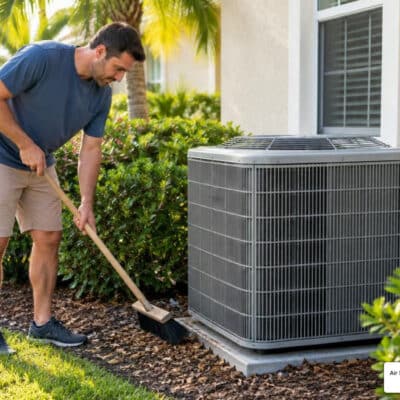
Walk outside and inspect the area immediately surrounding the metal condenser cabinet. Over time, growing shrubs, tall weeds, fallen tree branches, and windblown leaves can accumulate around the unit, choking off its supply of fresh air. You should maintain at least 2 feet of clear, unobstructed space around the entire perimeter of the outdoor unit, and at least 5 feet of clearance directly above it.
If the metal fins on the sides of the cabinet are caked with grass clippings, dirt, or dust, they will insulate the coils and prevent proper heat transfer. You can safely clean these coils by turning off the power at the outdoor disconnect switch and gently spraying the cabinet with a garden hose from the inside out. Never use a high-pressure washer, as the intense pressure will instantly bend and damage the delicate aluminum fins.
Keeping outdoor coils clean and clear of debris is one of the simplest ways to reduce strain on your compressor. If the unit still will not run after you restore airflow around it, a trained HVAC technician should inspect the electrical and mechanical components before the compressor overheats or fails prematurely under the heavy Florida sun.
5. Check for a Frozen Evaporator Coil
The evaporator coil is located inside your indoor air handler. When airflow is restricted by a dirty filter or when the system is low on refrigerant, the coil’s temperature drops below freezing. This causes the natural moisture in your indoor air to freeze instantly upon contact, encasing the coil in a thick block of ice.
Signs of a frozen evaporator coil include a noticeable drop in airflow coming from your supply registers, warm air blowing from your vents, or physical water pooling on the floor around your indoor unit. You can also inspect the insulated copper refrigerant line running into your indoor unit. If you see ice or frost forming on the brass valves or the exposed copper, your coil is frozen.
If you discover ice, you must take action immediately to protect your system. Turn your thermostat from Cool to Off, and switch the fan setting from Auto to On. This runs the indoor blower fan continuously without running the outdoor compressor, forcing warm indoor air over the frozen coil to speed up the thawing process. This melting process can take anywhere from 2 to 4 hours. Do not turn the cooling back on until the ice has completely melted. For a deeper look at managing a sudden system freeze, this AC emergency survival guide explains how to keep your home safer and drier while you wait for repairs.
6. Clear a Clogged Condensate Drain Line
As your air conditioner cools your home, it also dehumidifies the air. A standard system can extract several gallons of water from your indoor air every single day. This water collects in a drain pan beneath the evaporator coil and flows out of your home through a PVC condensate drain line.
In humid climates like Southwest Florida, algae, mold, and mildew thrive inside these dark, wet drain lines. Over time, this organic growth creates a thick clog. When the water cannot drain away, it backs up into the drain pan. Modern systems are equipped with a safety float switch that automatically cuts all power to the system when the drain pan begins to overflow, preventing catastrophic water damage to your ceilings and floors.
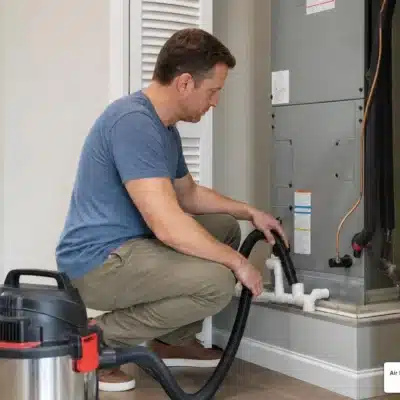
If your system has suddenly lost all power and your thermostat is completely blank, check the emergency drain pan. If you see standing water, your drain line is clogged. You can often clear this clog yourself by attaching a wet-dry vacuum to the outdoor end of the PVC drain line and sucking out the accumulated algae and debris. Once the line is clear, flush it from the inside with a cup of distilled white vinegar to kill any remaining organic growth. For ongoing drain, coil, and airflow protection, regular HVAC maintenance from Air Shield Heating & Cooling helps prevent the small issues that often shut an AC system down in Florida humidity.
When to Stop Troubleshooting and Call a Professional
While basic DIY checks are excellent for saving money, there is a clear boundary where homeowner troubleshooting must stop for safety and warranty reasons. High-voltage electrical cabinets and pressurized refrigerant systems present serious physical hazards.
If you have verified the power, replaced the filter, cleared the drain line, and allowed any ice to melt, but your system still refuses to blow cold air, it is time to call a professional. Continuing to run or repeatedly restart a malfunctioning system can quickly turn a simple component replacement into a total system failure. The emergency AC repair warning signs you should not ignore include repeated breaker trips, burning smells, refrigerant symptoms, and other issues that call for immediate expert help.
Recognizing Electrical Component Failures
Inside your outdoor unit sits a small but vital electrical component called a capacitor. The capacitor acts like a heavy-duty battery, storing up an electrical charge to provide the high-power boost required to start up your compressor and condenser fan motor.
In intense summer heat, capacitors are subjected to extreme thermal stress and commonly fail. Signs of a bad capacitor include a loud humming noise coming from your outdoor unit while the fan blade remains stationary, or a fan that will only spin if you gently push-start it with a wooden stick.
Another common electrical failure is a worn-out contactor, which acts as the physical switch that closes to send power to your compressor. Attempting to replace these high-voltage components yourself carries a severe risk of electrical shock, even when the main breaker is turned off, because capacitors can store lethal electrical charges long after power is disconnected.
Identifying Low Refrigerant and Sealed System Leaks
Your air conditioner does not consume refrigerant. It uses a permanently sealed loop of copper tubing filled with refrigerant to continuously absorb heat from inside your home and release it outdoors. If your system is low on refrigerant, it means you have a physical leak somewhere in your coils or line set.
Common signs of a refrigerant leak include:
- Warm air blowing from your supply vents while the outdoor unit is running.
- A persistent hissing or bubbling sound coming from your indoor or outdoor unit.
- Oily residue on the copper fittings or refrigerant coils, which indicates escaping compressor oil.
- Frequent coil freezing despite having a brand-new, clean air filter installed.
Handling refrigerant requires specialized tools, pressure gauges, and formal EPA Section 608 certification. It is illegal and highly dangerous for an unlicensed individual to handle or add refrigerant to a system.
For your home, rely on a licensed residential HVAC company to legally locate, seal, and recharge a leaking system. If you are experiencing cooling failures in Bradenton, FL, Sarasota, FL, Apollo Beach, FL, Bayshore Gardens, FL, Brandon, FL, Ellenton, FL, Fruitville, FL, Gibsonton, FL, or nearby Southwest Florida communities, Air Shield Heating & Cooling can help diagnose the problem and recommend the safest next step.
Understanding Repair Costs vs. System Replacement
When your system experiences a major component failure, you will face the classic decision of whether to invest in a professional repair or replace the entire system. Understanding general cost structures and system lifespans can help you make an informed financial choice.
| Service or Component | General Cost Description | Typical Lifespan or Recommendation |
|---|---|---|
| Diagnostic Service Call | Soft, generalized fee to cover travel and troubleshooting. | Highly recommended to pinpoint the exact failure. |
| Capacitor Replacement | Minor electrical repair. | Typically lasts 5 to 10 years; always repair. |
| Condensate Drain Clearing | Minor maintenance repair. | Highly preventable; repair immediately. |
| Condenser Fan Motor | Mid-range mechanical repair. | Repair if the system is under 12 years old. |
| Compressor Replacement | Major mechanical repair. | Consider replacement if the system is out of warranty. |
| Full System Replacement | Major capital investment. | Highly recommended for systems over 10 to 12 years old. |
If your system is more than 10 to 12 years old, it likely uses older, obsolete refrigerants like R-22, which have been completely phased out due to environmental regulations. Sourcing parts and refrigerant for these older systems is incredibly costly.
Additionally, modern systems are designed to meet strict SEER2 efficiency standards, meaning a new system can reduce your monthly energy bills by 20 to 40 percent. If you are trying to decide if your older unit has reached the end of its useful life, these AC replacement warning signs can help you evaluate your options objectively.
Preventing Sudden Failures with Regular Maintenance
The absolute best way to handle an AC breakdown is to prevent it from happening in the first place. Regular professional maintenance helps catch small electrical, airflow, and drainage problems before they become urgent no-cooling calls.
An annual professional tune-up does more than just keep your home cool during a heatwave. It can improve your system’s operating efficiency, which directly lowers your monthly utility bills. During a maintenance visit, a technician will clean your coils, test all electrical connections, measure motor amperages, clear your drain line, and identify tiny component weaknesses before they turn into major mid-summer breakdowns.
If you live in coastal areas like Manatee County, FL, the salt air and high humidity accelerate corrosion and can reduce a system’s average lifespan compared with drier inland areas. Regular maintenance is vital to protect your investment. You can schedule professional HVAC maintenance with Air Shield Heating & Cooling to keep your system running at peak performance year after year.
Frequently Asked Questions About AC Stopped Working What to Do
What is the very first thing I should check when my AC stopped working what to do?
The first step is to verify your thermostat settings. Ensure it is powered on, has fresh batteries, and is set to Cool mode with a target temperature 3 to 5 degrees below the current room temperature. Next, check your electrical panel for a tripped circuit breaker.
Why is my AC fan running but not blowing cold air?
If your indoor fan blows warm air, the cause is often a clogged air filter, a frozen evaporator coil, or a failed capacitor. It can also indicate a refrigerant leak or that the outdoor condenser unit has lost power due to a tripped breaker or turned-off disconnect switch.
Can a bad capacitor cause my AC to stop working suddenly?
Yes, a failed capacitor can cause your system to shut down or refuse to start. The capacitor provides the electrical boost required to start the compressor and fan motors. If it fails, you may hear a humming sound from the outdoor unit, but the fan and compressor will not run.
How do I reset my central AC unit after a power outage?
To reset your system, turn your thermostat to Off. Go to your electrical panel, switch the AC circuit breakers to Off, and then back to On. Turn your thermostat back to Cool and wait 3 to 5 minutes, as most systems have a built-in delay to protect the compressor.
Is it safe to keep resetting a tripped AC circuit breaker?
No, repeatedly resetting a tripped breaker is unsafe. Breakers trip to protect your home from electrical overloads. If it trips again after one reset, a serious electrical fault or failing compressor is likely present. Forcing a reset can cause permanent damage or an electrical fire.
How can I tell if my AC evaporator coil is frozen?
A frozen evaporator coil typically causes a dramatic drop in airflow, warm air blowing from vents, or visible ice on the copper refrigerant lines near your indoor unit. You might also notice water pooling on the floor around the indoor air handler.
What should I do if my AC stopped working what to do in a heatwave?
Turn the system off immediately to prevent compressor damage. Close all blinds and curtains to block out solar heat, keep doors shut, and stay hydrated. Set up a single room with portable fans and contact a professional HVAC company for emergency repairs.
Why is water overflowing from my AC drain pan?
Water overflows when the PVC condensate drain line is clogged with algae, mold, or debris. This backup can also occur if your condensate pump fails or if a frozen evaporator coil melts rapidly, overwhelming the drain pan’s capacity.
How often should I replace my home AC air filter?
Inspect your air filter every 30 days. Replace it every 1 to 2 months if you have pets, allergies, or multiple residents. In smaller, pet-free households, replacing the filter every 3 months is generally sufficient to maintain proper airflow.
When should I choose to replace my AC instead of repairing it?
Consider replacement if your system is over 10 to 12 years old, requires frequent repairs, or uses obsolete R-22 refrigerant. If a single repair estimate exceeds 50 percent of the cost of a new, energy-efficient system, replacement is usually the better financial choice.
Conclusion
When your air conditioner suddenly stops working, the rising heat and humidity inside your home can quickly turn a comfortable day into an urgent problem. By systematically working through the six basic checks, verifying your thermostat settings, replacing your air filter, and checking your electrical breakers, you can rule out the most common minor issues and potentially save yourself the cost of a professional service call.
However, when those basic troubleshooting steps do not restore your cooling, or if you encounter electrical failures, frozen coils, or suspected refrigerant leaks, you must prioritize your safety and the longevity of your equipment by stepping back and calling in a licensed expert.
If you are dealing with a cooling breakdown in Southwest Florida, you do not have to navigate the heat alone. Homeowners in Bradenton, FL, Sarasota, FL, Apollo Beach, FL, Bayshore Gardens, FL, Brandon, FL, Ellenton, FL, Fruitville, FL, Gibsonton, FL, and surrounding areas can turn to Air Shield Heating & Cooling for practical diagnostics, safe repairs, and honest guidance.
Whether you need fast emergency repairs, seasonal HVAC maintenance, or a complete system replacement, the team at Air Shield Heating & Cooling is ready to help. As a family-owned business serving Manatee County, FL since 2014, we are proud to offer 24/7 emergency response, free estimates, exclusive club memberships, and dedicated veteran discounts. If your AC stopped working and the basic checks did not solve it, contact our professional AC repair technicians for dependable help today.