
Why AC Filter Replacement Frequency Matters More in Florida
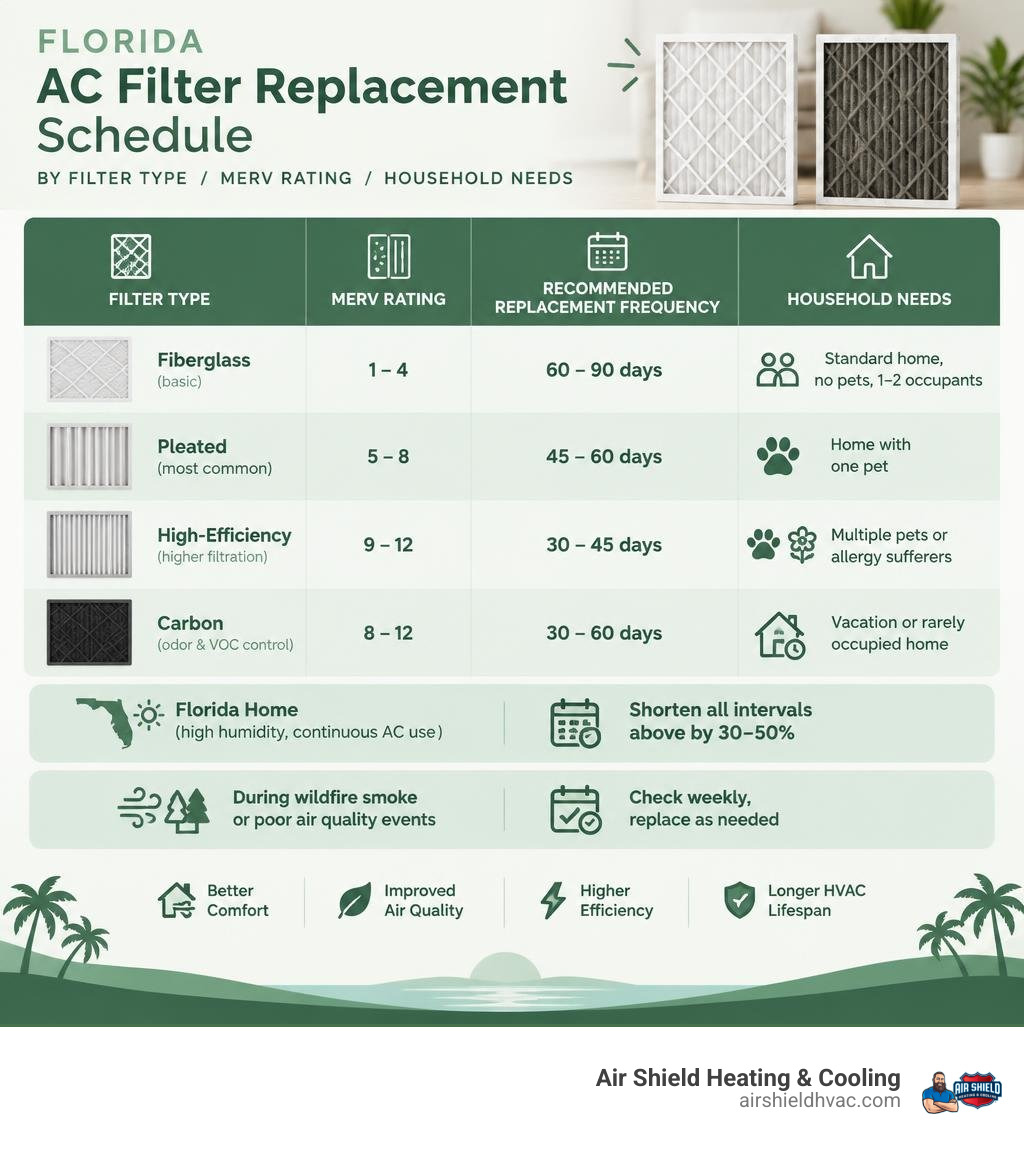
AC filter replacement frequency is one of the most important factors in keeping your home comfortable and your HVAC system running efficiently. Here is a quick answer based on filter type and household situation:
| Household Situation | Recommended Replacement Frequency |
|---|---|
| Standard home, no pets, 1-2 occupants | Every 60-90 days |
| Home with one pet | Every 45-60 days |
| Home with multiple pets or allergy sufferers | Every 30-45 days |
| Vacation or rarely occupied home | Every 6-12 months |
| Florida home (high humidity, continuous AC use) | Shorten all intervals above by 30-50% |
| During wildfire smoke or poor air quality events | Check weekly, replace as needed |
Most disposable filters last anywhere from one to six months under normal conditions, but Florida homeowners are not dealing with normal conditions. In Manatee County, where summer heat can push AC systems to run nearly around the clock, a filter that might last 90 days in a cooler climate can clog much sooner. High humidity, heavy pollen, and continuous cooling loads mean your filter may work harder than the manufacturer’s label suggests.
According to the U.S. Department of Energy, replacing a dirty, clogged filter can improve your system’s energy efficiency by 5 to 15 percent. That can make a meaningful difference on a Florida electric bill. Beyond efficiency, a neglected filter can contribute to frozen evaporator coils, blower motor strain, and a system breakdown at the worst possible time.
Our team has seen how a consistent AC filter replacement frequency can help homeowners protect comfort, airflow, and long-term HVAC performance throughout Manatee County, FL.
Understanding AC Filter Replacement Frequency in Humid Climates
Living in coastal and central Florida communities like Bradenton, FL, Sarasota, FL, and Lakewood Ranch, FL means AC systems face a unique set of environmental challenges. In more temperate states, homeowners might only run their AC during the peak of summer. In Florida, systems can operate for far more hours throughout the year.
Because AC systems run so often, the volume of air passing through the filter is significantly higher. Constant airflow means the filter captures dust, pet hair, mold spores, and outdoor pollen more quickly. Florida’s high humidity can also cause captured particles to bind together, creating a dense barrier on the filter media faster than in a dry climate.
When a filter becomes clogged, it restricts the air entering your system. That restriction makes the blower work harder, increases energy use, and accelerates wear on HVAC components. Regular HVAC maintenance gives a technician an opportunity to check airflow, inspect the system, and help prevent small filter-related problems from turning into larger repairs.
If weak airflow, uneven cooling, or repeated shutdowns persist after you replace the filter, prompt HVAC service can help identify whether another system issue is affecting performance.
For homeowners building a dependable routine, our article on why regular AC filter changes matter explains how clean filters support comfort, efficiency, and equipment protection.
Key Factors That Dictate Your Filter Lifespan
There is no single rule of thumb that fits every home perfectly. When our technicians visit clients in communities like Parrish, FL or Palmetto, FL, they explain that several variables determine how quickly a filter reaches the end of its useful life.
To establish an accurate schedule for your home, consider your household’s unique footprint. The primary factors include:
- Air Contaminants: Homes near active construction zones, unpaved roads, or those with indoor smokers will naturally load filters with debris faster.
- Occupancy Rate: A busy home with five family members circulating dust and skin cells will clog a filter faster than a home with a single occupant.
- Wildfire Smoke and Pollen: During heavy pollen seasons or periods when agricultural burns and distant wildfires affect local air quality, filters can load much faster than normal.
- System Settings: If you run your system with the thermostat fan set to “ON” instead of “AUTO,” the fan runs continuously, keeping air moving and filtering 24/7 and shortening the filter’s lifespan.
How Pets and Allergies Impact AC Filter Replacement Frequency
If you have furry family members, your AC filter is your first line of defense against pet hair and dander. Dogs and cats shed microscopic skin cells along with fur, which quickly get pulled into return-air vents. During seasonal shedding periods, a standard 1-inch filter can become heavily coated in fur within three to four weeks.
For households dealing with asthma, severe seasonal allergies, or respiratory sensitivities, keeping a fresh filter in place is especially important. A clean filter with an appropriate rating traps dust, mold spores, and outdoor pollen before they can recirculate through your living spaces. If someone in your home has respiratory concerns, inspect the filter every three weeks and replace it when it looks gray or loaded with debris. Our overview of indoor air quality solutions outlines complementary steps that can help reduce common airborne irritants.
Home Size and HVAC System Usage
The physical size of your home plays a major role in filter longevity. A larger home has a greater volume of air circulating through the system, which means more dust and debris reach the filter. However, larger homes often have multiple return vents or separate zoned systems that distribute the dust load across multiple filters.
Conversely, a small apartment or condo in Brandon, FL with only one return vent concentrates airborne dust on a single filter, requiring more frequent attention.
Seasonal residents in Longboat Key, FL or Holmes Beach, FL should also consider runtime. If a home is vacant for several months and the AC is set to a higher holding temperature, the system runs less often. In those vacation homes, a quality filter may last six months to a year because total runtime and dust accumulation are lower. Install a fresh filter before leaving and again when you return.
Types of AC Filters and Their Lifespans
Not all filters are created equal. The material, design, and physical thickness of the filter you buy will heavily influence how often you need to install a new one.
| Filter Type | Common Thickness | Average Lifespan (Standard) | Florida Lifespan (Peak Season) |
|---|---|---|---|
| Fiberglass | 1-inch | 30 days | 15-20 days |
| Standard Pleated | 1-inch | 60-90 days | 30-45 days |
| Deep Pleated Media | 4 to 5-inch | 6-9 months | 3-4 months |
| HEPA Systems | Variable | 12 months | 6-12 months |
| Washable / Reusable | 1-inch | Clean monthly | Clean monthly |
Fiberglass vs Pleated Filters
Fiberglass filters are the flat, see-through green or blue filters often sold in inexpensive multi-packs. While they are budget-friendly, they offer basic protection. Their primary purpose is to protect the AC blower from larger debris, not to provide high-level indoor-air filtration. Because they have little surface area, they clog quickly and may need replacement every 30 days, or every 15 to 20 days during a hot Bradenton, FL summer.
Pleated filters are made of folded synthetic fibers. The pleats create more surface area, allowing the filter to capture smaller particles without immediately restricting airflow. A standard 1-inch pleated filter can hold more dust than a fiberglass filter, typically lasting 30 to 45 days under heavy Florida usage and up to 90 days in milder seasons.
Media Filters and HEPA Systems
If your home has a dedicated media cabinet, you can use deep pleated media filters that are 4 to 5 inches thick. These filters contain substantially more filtering material than a standard 1-inch filter. Their larger surface area can help maintain airflow as dust accumulates, and they commonly need replacement every three to six months in a humid climate. Our guide to whole-home air filters can help you understand the role of these larger filtration setups.
True HEPA (High-Efficiency Particulate Air) filters capture very small airborne particles, but they are generally too restrictive for standard residential HVAC systems. Installing a HEPA filter in a system not designed for it can severely limit airflow and strain the blower motor.
How MERV Ratings Affect AC Filter Replacement Frequency
MERV stands for Minimum Efficiency Reporting Value. It is a scale from 1 to 16 that measures how effectively a filter traps particles of various sizes.
- MERV 1 to 4: Typically inexpensive fiberglass filters. They capture large particles but let much of the dust and pollen pass through.
- MERV 5 to 8: Residential pleated filters that capture dust, mold spores, and pet dander. This range is often a practical fit for Florida homes.
- MERV 9 to 12: Higher-efficiency filters that can trap finer dust and allergens.
- MERV 13 to 16: Highly efficient filters that may be too restrictive unless your HVAC system has been professionally evaluated for the added resistance.
As the MERV rating rises, the filter material becomes denser. A MERV 11 filter can clog faster than a MERV 8 filter because it captures smaller particles. If you choose a higher MERV rating, shorten your replacement cycle as needed to help prevent system strain.
Signs It Is Time to Change Your AC Filter
Our team recommends using the calendar as a reminder, then performing a quick visual check once a month.
Here are the classic warning signs that your filter has reached its capacity:
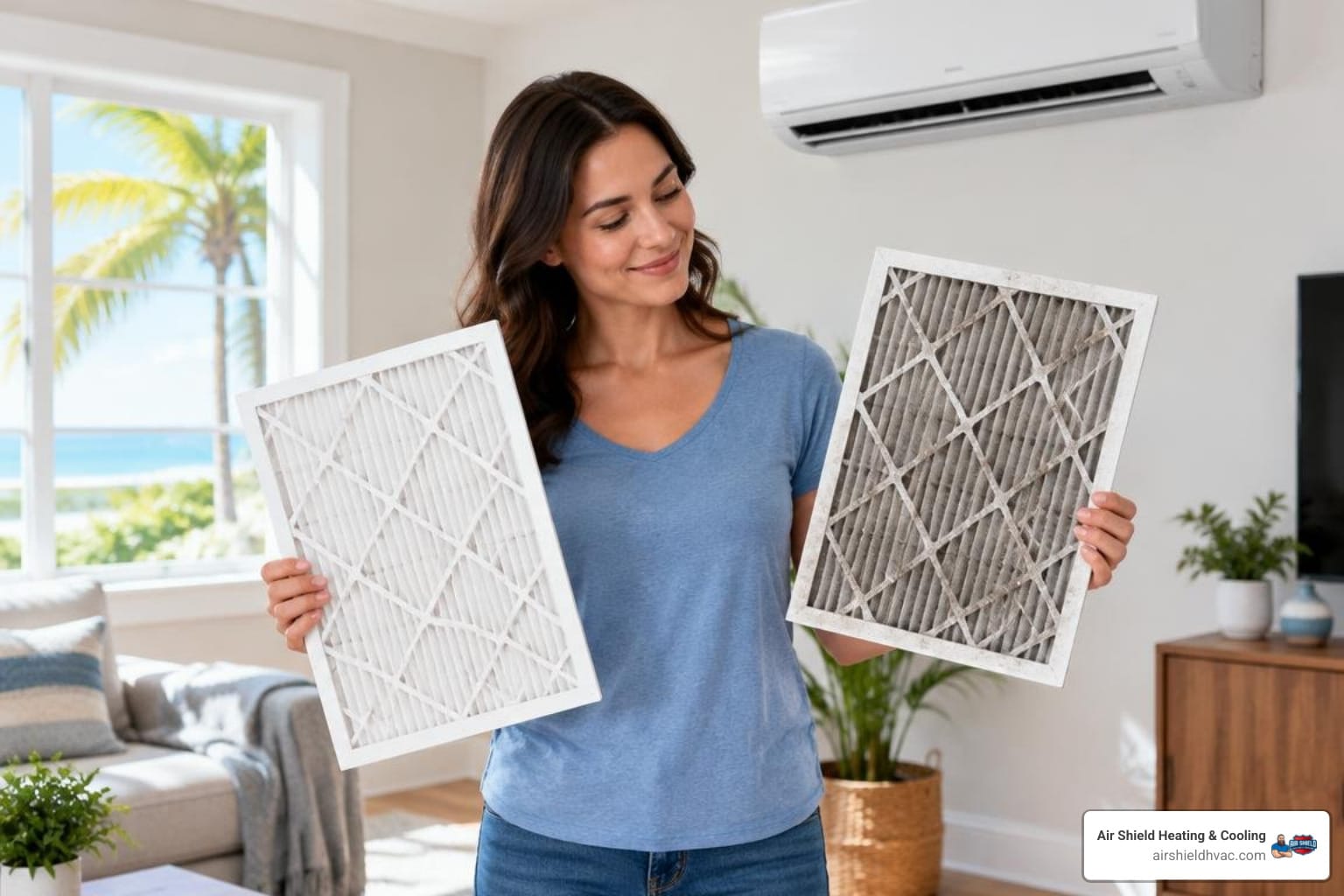
- The Light Test: Take your filter out and hold it up to a bright light source or the sun. If light cannot easily pass through the fibers, the filter is clogged and needs to be replaced immediately.
- Weak Airflow: If you notice that the air blowing out of your supply vents feels weaker than usual, a clogged filter is a likely cause.
- Excessive Dust: If you find yourself dusting furniture in Sarasota, FL or Palmetto, FL more often than usual, your filter may be saturated and allowing dust to bypass the system.
- Rising Energy Bills: When a filter is clogged, your AC may run longer cycles to cool your home, which can show up as an unexpected increase on your monthly electric bill.
- Musty Odors: A dirty filter can trap moisture from humid air, leading to a stale, musty smell whenever the system starts.
What Happens If You Neglect Your AC Filter?
Many homeowners treat filter changes as an optional chore, but neglecting this simple task can lead to serious and expensive consequences.
When airflow is restricted by a dirty filter, the cold air produced by your system’s evaporator coil cannot circulate properly through your home. This can cause the coil temperature to drop below freezing, turning condensation on the coil into ice. Once an evaporator coil freezes, your system may stop cooling, and melting ice can potentially cause water damage to nearby ceilings or drywall.
Restricted airflow also places added strain on the blower motor. Over time, that extra work can cause the motor to overheat and fail. Replacing a blower motor is a significant repair, while changing a filter is a simple preventive task.
Frequently Asked Questions About AC Filter Maintenance
How often should you change a 1-inch AC filter in Bradenton, FL?
In Bradenton, FL, you should inspect your 1-inch pleated filter every 30 days. During our hot, humid summer months when your system runs continuously, you will likely need to replace it every 30 to 45 days. In the milder winter months, you can stretch this to 60 days.
Can a dirty AC filter cause my system to freeze up?
Yes, absolutely. A dirty filter restricts the warm indoor air from flowing over your cold evaporator coil. Without that warm air to balance the temperature, the moisture on the coil freezes, causing a thick block of ice to build up and choke the system.
Is it safe to run my HVAC system without a filter?
No, you should never run your system without a filter, even for a single day. Doing so allows raw dust, pet hair, and debris to settle directly onto your evaporator coil and blower motor, which can cause severe mechanical damage and degrade your indoor air quality.
How do I know if my AC filter is dirty?
The easiest way is the light test. Pull the filter out and hold it up to a light bulb or window. If you cannot see light passing through the filter media, or if the surface is visibly gray and covered in dust, it is dirty and needs to be replaced.
Do expensive AC filters actually last longer?
Not necessarily. While high-quality pleated filters have more holding capacity than cheap fiberglass ones, highly restrictive high-MERV filters actually clog faster because they capture much smaller microscopic particles. Always choose a filter based on your household’s specific filtration needs rather than assuming price equals longevity.
How often should I change my AC filter if I have pets?
If you have one pet, you should change your filter every 45 to 60 days. If you have multiple pets or heavy-shedding breeds, you should inspect your filter every 30 days and replace it as soon as you see a layer of fur accumulating on the surface.
What is the difference between nominal and actual filter sizes?
The nominal size is the rounded-up size printed in large numbers on the side of the filter (like 20x20x1). The actual size represents the exact physical measurements of the filter, which are usually about a half-inch smaller. Always buy based on the nominal size printed on your current filter frame.
Should I change my AC filter more often during wildfire season?
Yes, wildfire smoke and agricultural burn particles are incredibly fine and will load a filter very quickly. During active smoke events, you should check your filter weekly and replace it as soon as it begins to look gray or dark.
Can I wash and reuse a disposable pleated AC filter?
No. Disposable pleated filters have cardboard frames and specialized synthetic fibers that will disintegrate or lose their electrostatic charge if they get wet. Washing them will destroy the filter’s structure and can lead to mold growth. Only wash filters that are explicitly labeled as reusable or washable.
How does a dirty filter affect my monthly energy bills?
A dirty filter restricts airflow, forcing your system to run longer and work harder to cool your home. This drop in efficiency can easily increase your monthly cooling costs by 5 to 15 percent, adding up to a significant amount of wasted money over a hot Florida summer.
Conclusion
Keeping up with your AC filter replacement frequency is a simple, cost-effective way to protect your home’s cooling system, lower monthly energy use, and support cleaner indoor air. Taking a few minutes to check the filter each month can help prevent avoidable breakdowns and keep your HVAC system running smoothly for years.
While replacing a standard AC filter is usually straightforward, safety should always come first. If safety concerns arise, specialized tools are required, HVAC electrical or mechanical components are involved, or you are unsure how to perform the task correctly, consult a qualified professional.
If you are unsure which filter size or MERV rating is right for your home, or you want to confirm that your system is operating efficiently before summer, the team at Air Shield Heating & Cooling is here to help homeowners across Bradenton, FL, Sarasota, FL, Lakewood Ranch, FL, and surrounding Manatee County communities.
For help with filter selection, airflow concerns, seasonal maintenance, or AC repairs, contact our professional AC maintenance technicians at Air Shield Heating & Cooling.