
AC Repair vs. Replace: How to Make the Right Call in Ellenton, FL
When it comes to AC repair vs replace, most homeowners want a straightforward answer before they spend a dollar. Here is a quick reference to help you decide:
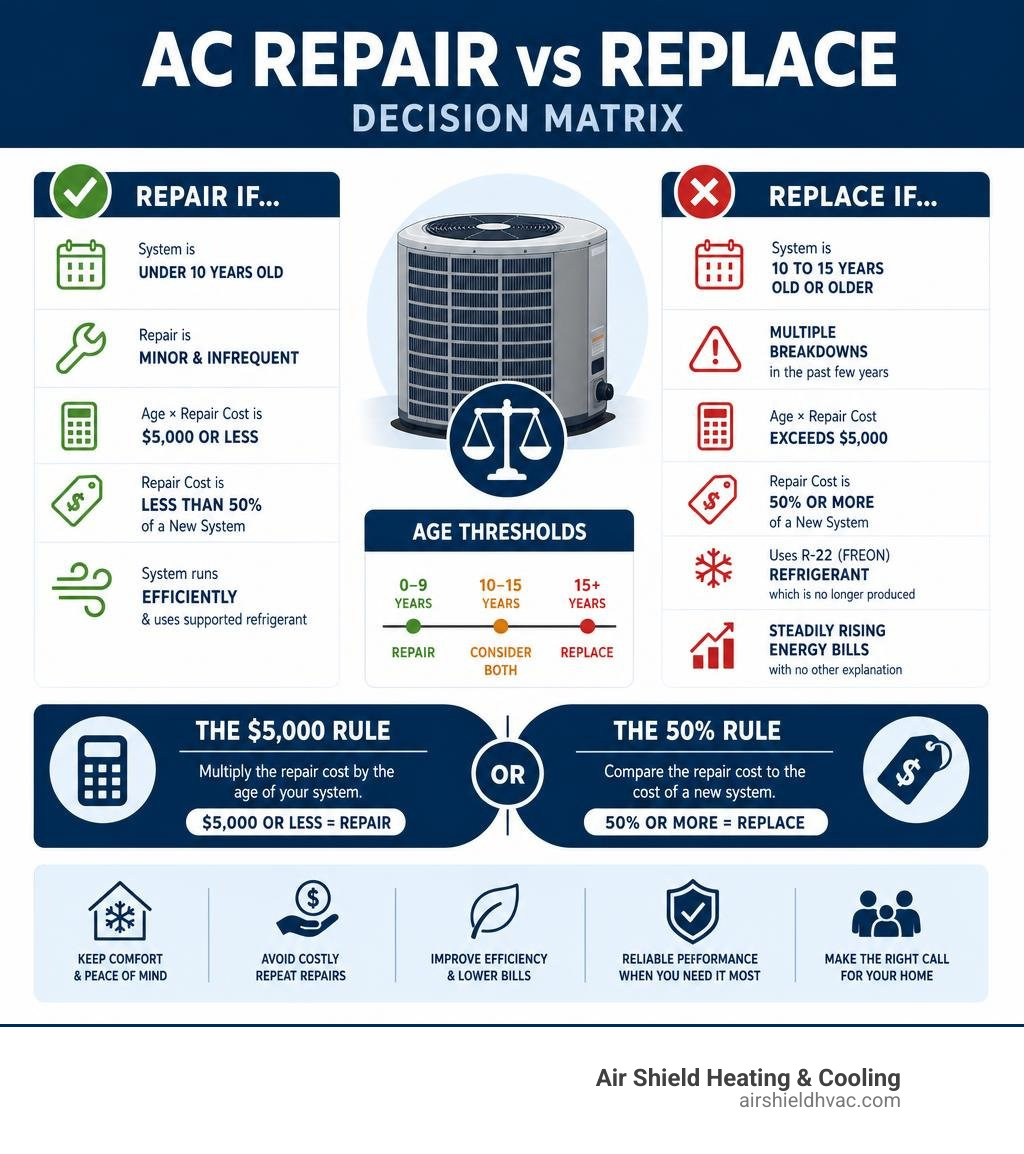
Repair your AC if:
- Your system is under 10 years old
- The repair is minor and infrequent
- The repair cost multiplied by the system’s age is under $5,000
- The repair cost is less than 50% of a new system’s price
- Your system still runs efficiently and uses supported refrigerant
Replace your AC if:
- Your system is 10 to 15 years old or older
- You have had multiple breakdowns in the past few years
- The repair cost multiplied by the system’s age exceeds $5,000
- The repair cost is 50% or more of what a new system would cost
- Your system uses R-22 (Freon) refrigerant, which is no longer produced
- You are seeing steadily rising energy bills with no other explanation
Few decisions feel more stressful for a homeowner than standing in a sweltering house in the middle of a Florida summer, wondering whether to fix what is broken or start fresh. The AC repair vs replace question hits differently here in Ellenton, FL, where the cooling season stretches up to eight months, humidity is relentless, and salt air from the coast quietly chips away at HVAC equipment year after year. What might be a borderline decision in a milder climate can become a much clearer call when your system is running nearly nonstop and fighting conditions that accelerate wear on every component.
The challenge is that there is no single answer that fits every situation. A unit that is eight years old and needs a minor fix is a very different conversation than a fifteen-year-old system that has already been repaired twice this season. Age, repair history, efficiency ratings, refrigerant type, and how long you plan to stay in your home all play a role. Getting that decision wrong in either direction costs real money, either in a repair that only delays the inevitable or in a premature replacement that was not yet necessary.
This guide walks through every factor that matters, from industry decision rules to Florida-specific considerations, so you can make a confident and informed choice.
I am Nick Pazanski, founder of Air Shield Heating & Cooling and an HVAC professional with over two decades of hands-on experience helping Manatee County homeowners navigate exactly this kind of AC repair vs replace decision. Having worked in this region since 1998, I have seen how Florida’s climate changes the calculus compared to what national guides typically describe. The sections ahead reflect that real-world experience.
Understanding the Lifespan of Florida HVAC Systems
When evaluating an HVAC system, the very first metric to consider is its physical age. However, a common mistake I see homeowners make is relying on national lifespan averages. In many parts of the country, a central air conditioner might easily last fifteen to twenty years because it only operates for a few months out of the year. In Florida, our systems work incredibly hard, running almost constantly from early spring through late autumn.
Because of this intense runtime, a typical air conditioner in coastal Florida has a shorter average lifespan, often lasting between ten and twelve years. The salt air present in areas like Bradenton Beach, FL, and Palmetto, FL, introduces corrosive elements that speed up the deterioration of delicate aluminum fins and copper coils. This process, known as galvanic corrosion, can cause refrigerant leaks to develop much sooner than they would in landlocked states.
Heat pumps face a similar timeline. Because they handle both heating and cooling, they are the workhorses of the home. In our mild winter climate, heat pumps are highly popular and efficient, but their continuous operational demand means they generally require replacement within ten to twelve years.
Furnaces, on the other hand, enjoy a much longer lifespan because they are rarely used in our region. A gas furnace in Ellenton, FL, can easily last fifteen to twenty-five years with proper care. However, because the heating components are rarely forced to work, they can suffer from rust and neglect if they are not serviced regularly.
Understanding how these timelines operate locally is essential before making any major financial commitments. To learn more about how our regional climate impacts your system over time, you can read my detailed guide on How Long Do HVAC Systems Last A Guide for Florida Homeowners. Additionally, if you are looking for proactive ways to protect your current unit from salt air and heavy usage, check out these practical tips to Extend ACs Lifespan Expert Care.
The Mathematical Approach to AC Repair vs Replace Decisions
When you are faced with a broken air conditioner, it is easy to let emotion or immediate budget constraints dictate your choice. To help remove the guesswork and emotion from the process, the HVAC industry relies on two primary mathematical guidelines: the $5,000 rule and the 50% rule.
The $5,000 rule is a simple, time-tested formula. You multiply the exact age of your AC system by the written repair estimate you received from a technician. If the resulting number is over $5,000, the industry standard recommends replacing the system. If the number is under $5,000, a repair is generally considered a sound financial investment.
For example, let us look at two different scenarios:
- Scenario A: You have a five-year-old system that needs a new fan motor. The repair estimate is $400. Multiplying 5 by 400 gives you $2,000. Because this is well below the $5,000 threshold, repairing the unit is clearly the smarter, more cost-effective choice.
- Scenario B: You have a twelve-year-old system with a failed compressor. The repair estimate is $600. Multiplying 12 by 600 gives you $7,200. Because this total exceeds the $5,000 threshold, investing that money into a system that is already nearing the end of its operational life is a poor long-term investment. You would be much better off putting those funds toward a modern replacement.
The 50% rule is even simpler. If the cost of a single repair exceeds 50% of the price of a brand-new, fully installed system, you should opt for replacement. Spending half the value of a new, warranted system to keep an aging, out-of-warranty unit running rarely makes financial sense.
To help you visualize how these rules compare, I have put together a quick comparison table below.
| Decision Rule | Formula / Criteria | Best Used For | Action Threshold |
|---|---|---|---|
| The $5,000 Rule | System Age $times$ Repair Cost | Older systems with moderate repairs | Replace if the total exceeds $5,000 |
| The 50% Rule | Repair Cost vs. New System Cost | Systems of any age facing major component failures | Replace if the repair cost is $ge$ 50% of a new system |
Tracking your system’s repair history over a three-year window is also critical. If you have had three or more repairs within the last three years, you may be caught in a “repair spiral.” Each individual fix can seem manageable on its own, but the combined cost often grows quickly while the system continues to become less reliable and less efficient. At that point, putting the same money toward a newer, warrantied system may be the smarter long-term choice.
Key Signs It Is Time for AC Installation in Ellenton, FL
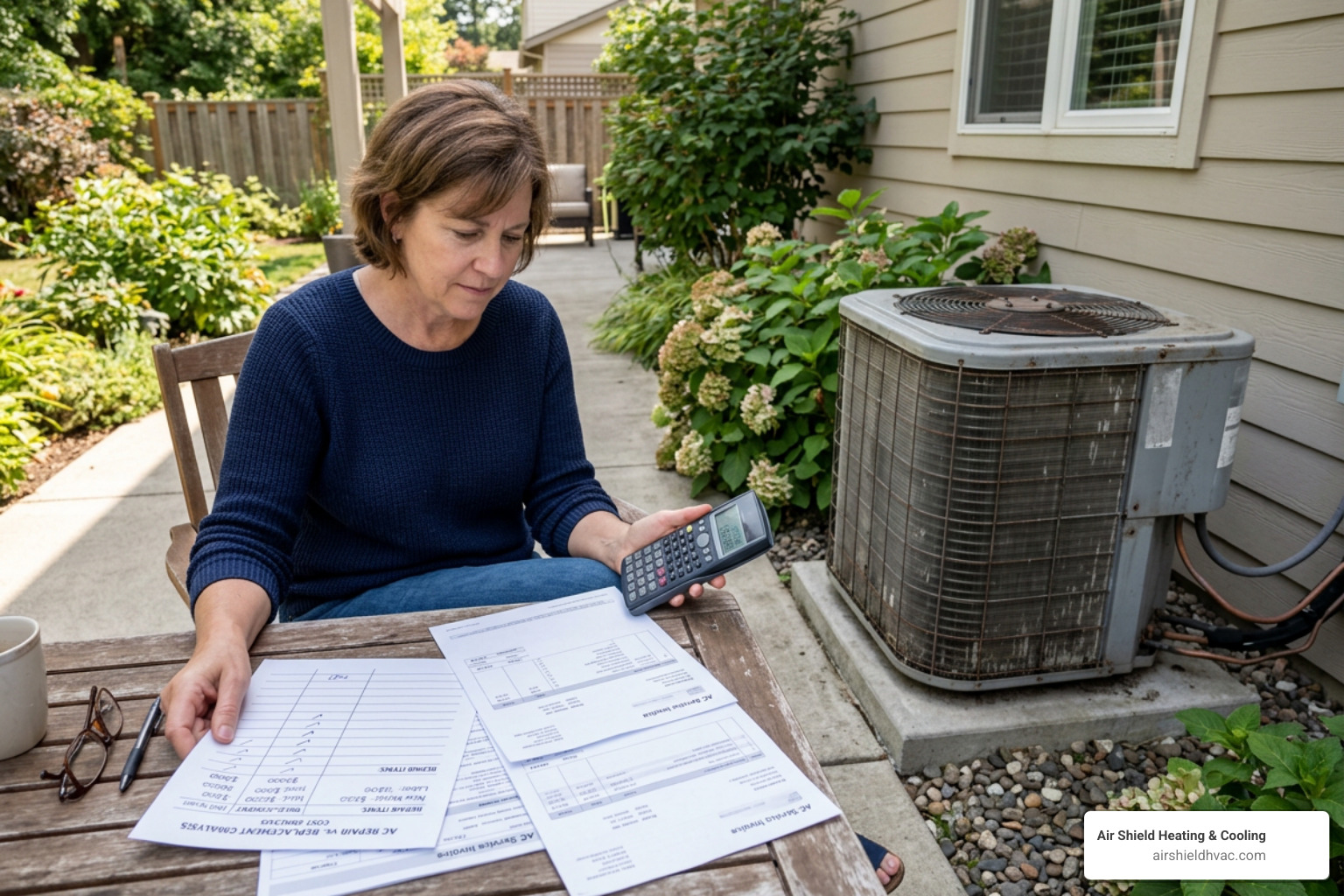
While mathematical formulas provide excellent guidance, your air conditioner will also show physical signs of decline when it is reaching the end of its useful life. Recognizing these warning signs early can save you from an emergency breakdown during the hottest week of July.
The most obvious sign is a pattern of frequent breakdowns. If you find yourself on a first-name basis with your HVAC technician, your system is telling you that its internal components are failing systematically. When one major part wears out, it places extra strain on the remaining components, leading to a domino effect of consecutive failures.
Rising energy bills are another major indicator. As an air conditioner ages, mechanical wear, dirty coils, and minor refrigerant leaks force the compressor and fan motors to work much harder to achieve the same cooling effect. If your monthly utility bills are steadily climbing but your usage habits have not changed, your system’s efficiency is dropping.
You should also pay close attention to comfort and performance. Inconsistent cooling, warm air blowing from the registers, and high indoor humidity are clear signs of trouble. In Florida, dehumidification is just as important as cooling. If your home feels sticky or damp even when the AC is running, the system is no longer moving air or removing moisture effectively.
Finally, major component failures, such as a burnt-out compressor or a leaking evaporator coil, are often the final straw. These parts are incredibly expensive to replace, and on a system that is more than ten years old, a failure here almost always signals that it is time for a fresh start.
If you notice these symptoms in your own home, it is worth reading about the clear Signs AC Ready for Replacement. For those living in neighboring areas, you can also explore whether Is It Time for AC Installation in Sarasota to see how local conditions affect homes across our region.
How 2026 Efficiency Standards and Refrigerant Phase-Outs Impact Your Choice
The HVAC industry is heavily regulated, and major environmental and efficiency standards have shifted significantly. If you are trying to decide whether to repair an older system or invest in a new one, these regulatory changes should play a massive role in your decision.
Evaluating Energy Efficiency and the AC repair vs replace Equation
In recent years, the Department of Energy has enforced stricter efficiency metrics, known as SEER2 (Seasonal Energy Efficiency Ratio 2), AFUE (Annual Fuel Utilization Efficiency) for heating, and HSPF2 (Heating Seasonal Performance Factor 2) for heat pumps. These standards require all newly manufactured systems to meet higher baseline efficiencies.
If you are replacing a system that is ten to twelve years old, you are likely transitioning from an older 8 or 10 SEER unit to a modern system rated at 14.3 SEER2 or higher. This efficiency jump is substantial. Upgrading to a modern, energy-efficient system can reduce your monthly cooling costs by 20% to 40%. If you opt for an ENERGY STAR certified model, you can save an additional 15% on top of those savings. Over the lifespan of the system, these monthly savings can offset a significant portion of the initial installation cost.
Those efficiency gains are worth weighing against the upfront cost of a new system. A replacement may cost more at installation, but lower monthly utility bills, stronger warranty coverage, and fewer repair calls can make it the better long-term investment for an aging AC system.
The R-22 Refrigerant Dilemma in AC repair vs replace Decisions
One of the most critical factors in the AC repair vs replace decision is the type of refrigerant your system uses. If your air conditioner was installed before 2010, there is a very high probability that it operates on R-22 refrigerant, commonly known as Freon.
The Environmental Protection Agency completely phased out the production and import of R-22 due to its ozone-depleting properties. Because the supply of R-22 is now extremely scarce, the cost of acquiring this refrigerant has skyrocketed. A single recharge for an older system can easily cost hundreds or even thousands of dollars, with no guarantee that the system won’t leak again a few weeks later.
If your R-22 system develops a refrigerant leak or compressor failure, attempting a repair is almost never a wise financial move. Modern systems use environmentally friendly refrigerants that are widely available and far less expensive to service. To understand what is involved in these types of complex system repairs, you can read about What Happens in HVAC System Repair.
Safety Red Flags and Component Replacement Strategies
While financial formulas and efficiency ratings are incredibly helpful, some situations bypass the debate entirely. Safety should always be your top priority.
If you have a gas furnace or a hybrid heating system, a cracked heat exchanger is an immediate safety red flag. A cracked heat exchanger can leak carbon monoxide, an odorless, colorless, and potentially lethal gas, directly into your home’s airflow. If a certified technician discovers a cracked heat exchanger, the system must be shut down immediately, and replacement is the only safe option. Similarly, severe electrical hazards, scorched wiring inside the condenser, or recurring gas leaks require immediate, professional intervention.
If you do decide to replace, you will face another choice: should you replace only the broken component or the entire system?
I always recommend replacing your indoor and outdoor units together as a matched set. Your indoor evaporator coil and outdoor condenser are engineered to work together. If you pair a brand-new, high-efficiency outdoor condenser with an old, dirty indoor coil, several problems will occur:
- Reduced Efficiency: The system will never reach its rated SEER2 efficiency, costing you more on your monthly bills.
- Premature Wear: The mismatched components will cause improper pressure and temperature levels, placing extra strain on the new compressor and leading to an early failure.
- Voided Warranties: Most major manufacturers will not honor their parts warranty if the outdoor unit is not paired with a certified, matching indoor coil.
Taking the time to properly size and match your new system ensures comfort, safety, and long-term reliability. For expert advice on selecting the correct equipment size for your home, you can read What Size HVAC Unit Do I Need Expert Advice for Choosing Wisely. If your repair-vs-replacement decision points toward a new system, Air Shield Heating & Cooling can help you compare properly matched equipment through our air conditioning installation services.
Frequently Asked Questions about AC Repair vs. Replacement
What is the $5,000 rule for AC repair vs replace?
The $5,000 rule is an industry guideline where you multiply the age of your air conditioner in years by the estimated cost of the repair. If the total is greater than $5,000, it is generally more cost-effective to replace the system. If the total is less than $5,000, proceeding with the repair is usually the better choice.
How long does a typical AC unit last in Ellenton, FL?
Due to our intense heat, high humidity, and coastal salt air, a typical air conditioner in Ellenton, FL, lasts about ten to twelve years. This is slightly shorter than the national average of fifteen years because systems in Florida run almost constantly for up to eight months out of the year.
Is it worth repairing an AC unit that uses R-22 refrigerant?
In almost all cases, no. R-22 refrigerant has been phased out completely by the EPA, making it scarce and incredibly expensive to source. If your older system has a refrigerant leak, the cost of repairing the leak and recharging the system with R-22 can easily approach the down payment on a new, energy-efficient system.
What are the signs that my AC needs immediate replacement?
Key signs include a system that is over twelve years old, a history of frequent and costly repairs, steadily climbing energy bills, inconsistent cooling, and an inability to keep indoor humidity levels comfortable. Major component failures, such as a failed compressor or a severely leaking coil, also indicate it is time to replace.
Should I replace my furnace and AC at the same time?
Yes, it is highly recommended to replace both systems at the same time. Because they share the same blower motor and ductwork, installing a matched system ensures optimal airflow, maximizes energy efficiency, and prevents mismatched components from causing premature wear on your new equipment.
How much can I save on my energy bills by upgrading to a new AC?
Upgrading from an older, inefficient system to a modern unit that meets the current SEER2 standards can reduce your monthly cooling costs by 20% to 40%. Selecting an ENERGY STAR certified model can provide an additional 15% in monthly energy savings.
What safety issues require immediate HVAC system replacement?
The most critical safety issue is a cracked heat exchanger in a gas furnace, which can leak dangerous carbon monoxide into your home. Other safety red flags include severe, recurring electrical faults, scorched control boards, and persistent gas leaks that cannot be safely repaired.
Does a new AC installation increase home value in Florida?
Yes. Because air conditioning is absolutely essential in Florida, home buyers pay close attention to the age and condition of the HVAC system. A brand-new, high-efficiency system with a transferable warranty adds peace of mind and tangible value to your home during a sale.
How do 2026 SEER2 standards affect my repair vs replace decision?
The 2026 SEER2 standards require all new air conditioning systems to meet higher baseline efficiency ratings. While this can slightly increase the initial cost of a new system, it guarantees that any replacement system you purchase will be significantly more efficient, leading to greater long-term energy savings.
How often should I schedule AC maintenance to avoid early replacement?
In Florida, you should schedule professional AC maintenance twice per year. Regular bi-annual tune-ups before the peak summer heat and ahead of the winter months allow technicians to clean coils, clear drain lines, and catch minor issues before they turn into expensive breakdowns.
Whether you need fast AC repairs, seasonal HVAC maintenance, or a complete system replacement, the team at Air Shield Heating & Cooling is ready to help. To discuss the right next step for your home, contact our professional AC repair and replacement technicians today.