
What Does AC Capacitor Replacement Cost in Florida?
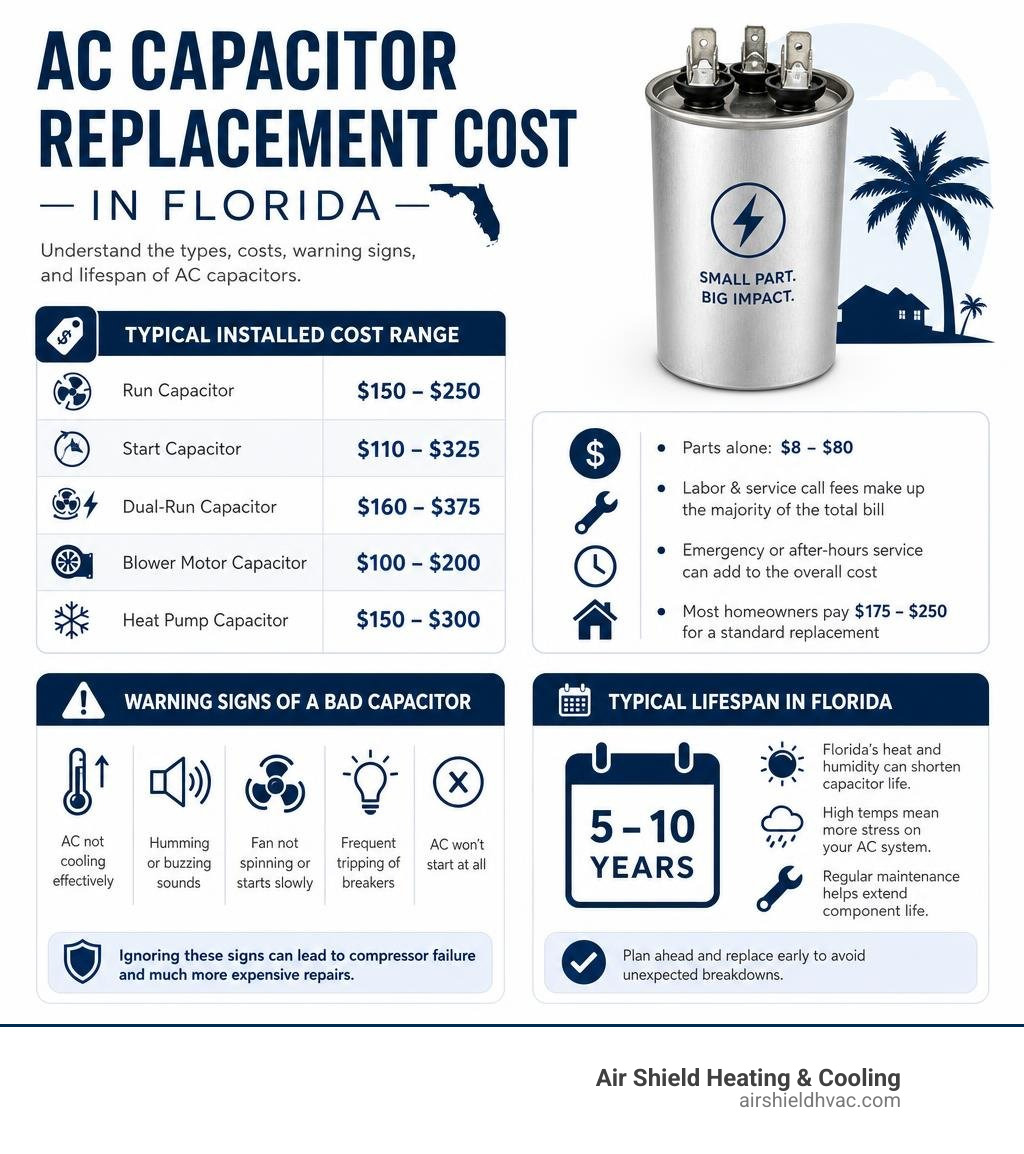
Capacitor replacement cost for a residential AC system in Florida typically falls somewhere between $150 and $400, depending on the type of capacitor, labor involved, and when you need the service. Here is a quick breakdown to answer the most common questions upfront:
Quick Answer: AC Capacitor Replacement Cost
| Capacitor Type | Typical Installed Cost Range |
|---|---|
| Run capacitor | $150 – $250 |
| Start capacitor | $110 – $325 |
| Dual-run capacitor | $160 – $375 |
| Blower motor capacitor | $100 – $200 |
| Heat pump capacitor | $150 – $300 |
- Parts alone generally range from $8 to $80 depending on the capacitor type and specifications
- Labor and service call fees make up the majority of the total bill
- Emergency or after-hours service can add to the overall cost
- Most homeowners pay in the range of $175 to $250 for a standard replacement during a scheduled visit
- Costs may vary based on your location, system type, and whether additional diagnostics are needed
Pricing can vary depending on several factors specific to your home and system, so always request a professional estimate before any work begins.
A failed capacitor is one of the most common reasons an AC system stops cooling on a sweltering Florida afternoon. In Manatee County, FL, where summer temperatures push outdoor units to their limits for months at a time, capacitors wear down faster than they would in cooler climates. Most homeowners do not think about this small electrical component until the AC stops working entirely and the indoor temperature starts climbing fast.
The good news is that a capacitor replacement is one of the more straightforward AC repairs when it is caught early. The challenge is knowing what to look for, understanding what drives the final cost, and making sure the repair is done correctly the first time so it does not lead to a much more expensive compressor failure down the road.
The Air Shield Heating & Cooling team brings decades of hands-on HVAC experience to homeowners throughout Manatee County and the surrounding Florida communities. Our technicians have diagnosed and repaired countless failed capacitors, so this guide gives you a clear, honest picture of what AC capacitor replacement cost actually looks like and what affects it. In the sections below, we will walk through how capacitors work, what causes them to fail, what warning signs to watch for, and how to make a smart decision when your system needs attention.
Understanding the Role of an AC Capacitor in Your Cooling System
To understand why a tiny, cylinder-shaped part is so critical to your comfort, it helps to understand some HVAC basics. Think of your AC capacitor as a temporary, high-powered battery. While your home electrical system provides a steady flow of electricity, it does not quite have the raw strength to single-handedly start the heavy-duty motors inside your outdoor unit. This is where the capacitor steps in.
An AC capacitor stores up an electrical charge and releases it in a powerful burst to provide the necessary starting torque. This intense jolt of energy is what gets the compressor motor and the outdoor fan motor spinning. Once these motors are running, a different type of capacitor provides a continuous, steady stream of energy to keep them operating smoothly.
During normal operation, AC capacitors work under intense electrical and heat-related stress. If the capacitor fails, the motors may try to start but lack the power needed to spin. Instead, they can sit there humming and overheating, which can quickly lead to burnt-out motors and a much more expensive repair bill.
What Factors Influence Your Total AC Capacitor Replacement Cost?
When you receive a quote for AC capacitor replacement cost in 2026, the final number is determined by several distinct variables. It is rarely as simple as buying a cheap part online and swapping it out. Here is what actually goes into the pricing:
- Capacitance Rating: Capacitors are measured in microfarads (µF). Larger AC systems require capacitors with higher capacitance ratings to handle the larger electrical load. Higher microfarad ratings generally cost slightly more.
- Voltage Requirements: Residential AC capacitors are typically rated for either 370 volts or 440 volts. A 440-volt capacitor can safely replace a 370-volt model, but never the other way around. Higher-voltage components carry a slightly higher price tag.
- Accessibility: If your outdoor condenser unit is easily accessible on the ground in Bradenton, FL, the job is quick. However, if the unit is located on a steep roof, in a tight crawlspace, or behind dense landscaping, the extra labor time will increase the cost.
- Emergency Service: If your AC breaks down at 2:00 PM on a Sunday in July, you will likely pay more for an emergency dispatch than you would for a scheduled weekday visit.
Understanding what happens in HVAC system repair can help you see why professional diagnostics are so important. A technician does not just swap the part: they test the voltage, check the motor amp draws, and ensure there is not an underlying issue causing the capacitor to fail. If testing points to broader airflow or distribution problems, professional ductwork repair and installation can also help the system move conditioned air more effectively instead of forcing the AC to work harder than necessary.
The table below outlines the differences in specifications and roles for the main types of capacitors found in modern Florida cooling systems:
| Capacitor Type | Primary Function | Typical Voltage Rating | Average Part Cost |
|---|---|---|---|
| Single-run | Powers either the fan or compressor | 370V – 440V | $10 – $35 |
| Dual-run | Powers both fan and compressor | 370V – 440V | $15 – $50 |
| Start capacitor | Provides initial starting torque | 125V – 330V | $15 – $40 |
| Blower capacitor | Powers the indoor blower motor | 370V | $10 – $25 |
Average AC Capacitor Replacement Cost by Component Type
The specific role the capacitor plays in your system directly impacts the capacitor replacement cost. Let us look at the distinct types of capacitors you might find in your air conditioner or heat pump:
- Run Capacitor: This component stays active the entire time your AC is running, providing continuous power to keep the compressor or fan motor spinning at the correct speed.
- Start Capacitor: This is designed to provide a brief, powerful burst of electrical torque to get a struggling motor moving, and then it immediately drops out of the circuit.
- Dual-run Capacitor: This is the most common type found in modern residential AC units. It combines two capacitors into a single metal cylinder, simultaneously supporting both the outdoor fan motor and the compressor. Because it does double duty, replacing a dual-run capacitor is slightly more involved.
- Blower Motor Capacitor: Located inside your indoor air handler, this capacitor is responsible for starting and running the indoor blower fan that pushes cool air through your ductwork.
- Heat Pump Capacitor: Heat pumps operate year-round for both heating and cooling, subjecting their capacitors to constant wear. These often require specialized specifications to handle reversing valve operations and defrost cycles.
How Labor and Location Affect Your AC Capacitor Replacement Cost
Where you live in Florida plays a significant role in what you can expect to pay. In Manatee County, FL, local labor rates, drive times, and seasonal demand all shape the final invoice.
If you live in Bradenton, FL, or Sarasota, FL, local service call fees and diagnostic charges typically range from $80 to $150. This fee covers the technician’s time, travel, and the specialized diagnostic tools needed to test your electrical system. Many reputable local contractors will waive or reduce this diagnostic fee if you approve the repair on the spot.
Seasonal demand is another huge factor. During the mild winter months, you might find off-season specials or lower diagnostic rates. If you plan ahead and schedule HVAC repair in Palmetto before spring, you can often avoid the peak-season rush and secure more flexible scheduling. Conversely, during the extreme heat of mid-summer, emergency after-hours calls will naturally command a premium due to the sheer volume of homeowners facing cooling emergencies.
Warning Signs of Failure and Why Professional Service Is Essential
Capacitors rarely fail completely without warning. Usually, they give off a few distinct clues that they are on their last legs. Catching these signs early can save you from a hot, sleepless night and prevent permanent damage to your compressor. Watch out for these common warning signs:
- A Loud Humming Noise: If you hear a loud, low-pitched humming or buzzing sound coming from your outdoor unit, but the fan is not spinning, your capacitor is likely dead. The motor is getting power but lacks the starting torque to begin spinning.
- AC Blowing Warm Air: If your indoor vents are blowing warm air, the outdoor compressor may have failed to start due to a bad capacitor, even if the indoor fan is still running.
- Hard Starting: If your AC hesitates, stutters, or takes several seconds of clicking and groaning to turn on, the start capacitor is struggling to deliver the necessary power.
- System Shutting Off Randomly: A failing capacitor can cause voltage fluctuations, triggering your system’s built-in safety switches to shut the AC down shortly after it starts.
- A Bulging or Leaking Capacitor: If you look inside the electrical panel of your outdoor unit and see that the top of the silver cylinder is bulged, domed, or actively leaking oil, it has experienced a thermal blowout and must be replaced immediately.
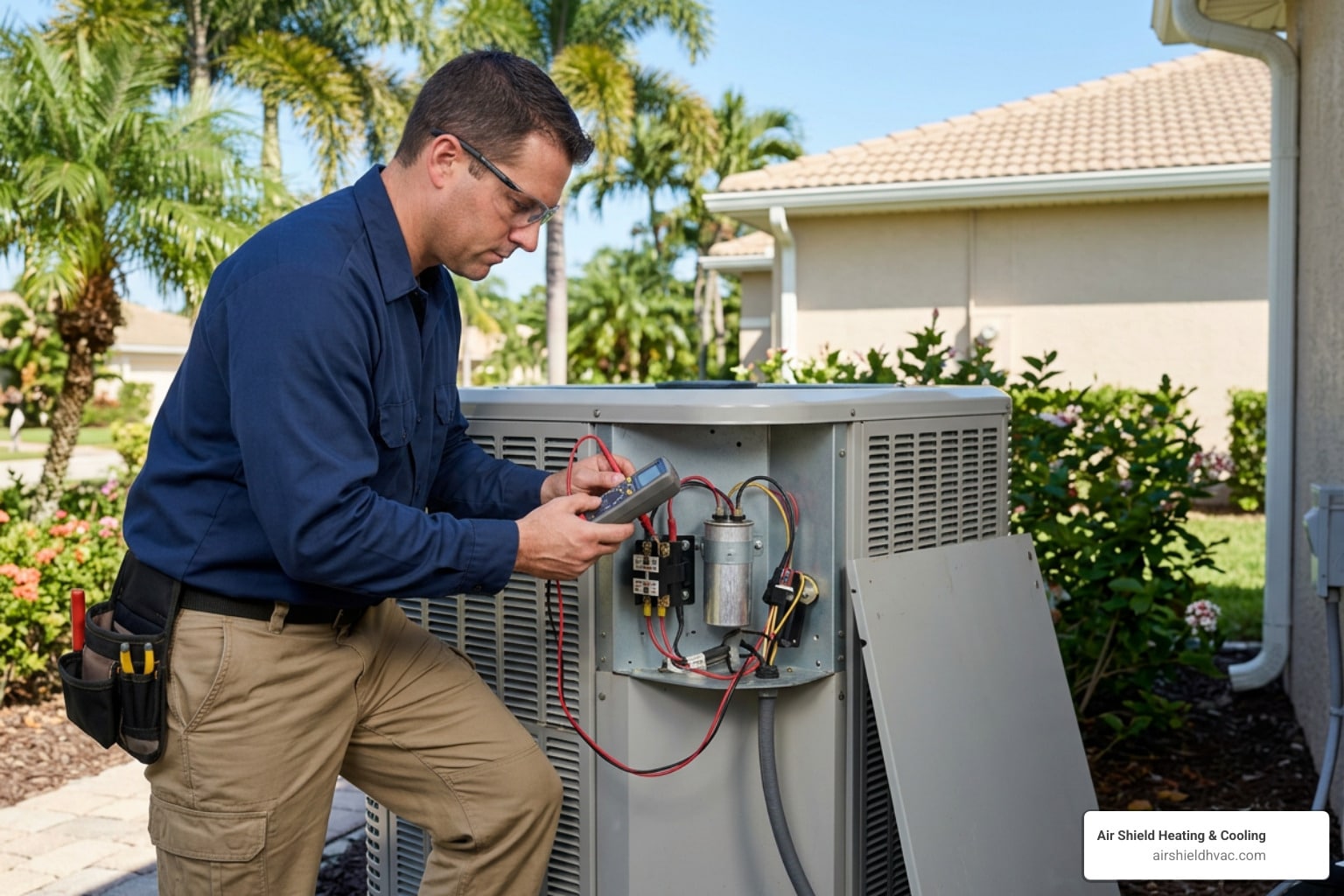
While it might be tempting to treat this as a quick weekend DIY project, replacing a capacitor yourself is incredibly dangerous. Capacitors are electrical storage devices: they function like high-powered batteries that hold a lethal electrical charge long after the main power breaker has been turned off. Touching the terminals of a charged capacitor without the proper training and insulated discharge tools can result in severe electrical shock, serious injury, or death.
Furthermore, installing a capacitor with the incorrect microfarad or voltage specifications can quickly ruin your compressor. A compressor replacement is one of the most expensive repairs in the industry, often prompting homeowners to look for signs your AC is ready for replacement rather than paying for a fix.
Hiring AC repair specialists in Palmetto’s weather ensures that the job is done safely, the electrical specifications are perfectly matched to your system, and any manufacturer warranties remain fully intact. For homeowners who want a professional inspection before a small capacitor issue becomes a larger breakdown, Air Shield Heating & Cooling can evaluate the system, confirm the correct part specifications, and recommend the right repair path.
Frequently Asked Questions About AC Repair in Florida
What is the typical lifespan of an AC capacitor in Florida?
While manufacturers design capacitors to last anywhere from 10 to 15 years under perfect conditions, the reality in Florida is quite different. The combination of extreme summer heat, high humidity, and constant system cycling means most capacitors in our area last between 5 and 8 years. It is very common to replace a capacitor at least once during the lifespan of a standard AC system.
Can I run my AC with a bad capacitor?
No, you should never run your AC with a known bad capacitor. Doing so forces the fan and compressor motors to draw excessive electrical current as they try to start. This extra strain causes the motors to overheat rapidly, which can burn out their internal wiring and lead to complete motor or compressor failure.
Why do AC capacitors fail more frequently in hot climates?
Heat is the number one enemy of electrical components. The interior of an outdoor condenser unit sitting in the direct Florida sun can easily exceed 140 degrees. This extreme heat breaks down the delicate liquid electrolyte and chemical seals inside the capacitor, causing it to lose its ability to hold a charge and eventually bulge or burst.
How long does it take a professional to replace an AC capacitor?
For a trained and licensed technician, the actual replacement process is very quick, usually taking between 30 and 45 minutes. This time includes safely shutting down the power, discharging the old capacitor, mounting the new one, verifying the wiring, and testing the entire system’s electrical draw upon startup.
What is the difference between a start capacitor and a run capacitor?
A start capacitor provides a brief, high-torque electrical boost to get the compressor or fan motor moving from a dead stop, and then it immediately switches off. A run capacitor stays active the entire time the system is running, providing continuous, stable phase-shifting power to keep the motors spinning efficiently.
Can a bad AC capacitor damage my compressor?
Yes, absolutely. If the run capacitor is weak or failing, the compressor will run at a higher operating temperature and draw more amperage than it is designed to handle. Over time, this constant electrical strain will degrade the compressor’s internal motor windings, eventually leading to a complete mechanical burnout.
How do I know if my AC capacitor is bad or if it is the fan motor?
If the capacitor is bad, you will often hear a humming sound from the outdoor unit, and you can sometimes get the fan spinning by gently pushing it with a thin stick through the top grille. If the fan motor itself is bad, the blades may feel stiff or completely seized when you try to turn them manually with the power safely disconnected.
Does replacing an AC capacitor improve energy efficiency?
Yes. When a capacitor begins to degrade, the compressor has to work much harder and draw more electrical current to start and run. By replacing a weak capacitor with a fresh, properly rated component, you restore the system’s electrical efficiency, which can help lower your monthly power bills.
Is there a warranty on a replacement AC capacitor?
Yes, most professional HVAC contractors provide a warranty on both the replacement part and the labor. Standard parts warranties for high-quality, professional-grade capacitors typically range from 1 to 5 years, while labor warranties usually cover the service for 30 days to a full year.
Can a homeowner safely replace an AC capacitor themselves?
No, it is highly discouraged. Because capacitors store high-voltage electrical charges even when the system is completely unplugged, handling them without professional safety gear and proper discharging tools carries a high risk of severe electrical shock. Additionally, choosing the wrong size or wiring it incorrectly can permanently destroy your system’s compressor.
Conclusion
When your air conditioner stops blowing cold air, a failed capacitor is often the culprit. While the AC capacitor replacement cost is one of the more manageable repairs in the HVAC world, ignoring the warning signs can quickly turn a simple fix into a catastrophic system failure.
By understanding the warning signs, keeping your outdoor unit clean, and relying on professional technicians to handle high-voltage components, you can keep your home cool and comfortable all year long. If you suspect your system is struggling or are dealing with a cooling emergency, the Air Shield Heating & Cooling team is ready to help.
Whether you need fast AC repairs, seasonal HVAC maintenance, or a complete system replacement, contact our professional AC repair technicians and let us restore your peace of mind and home comfort.